

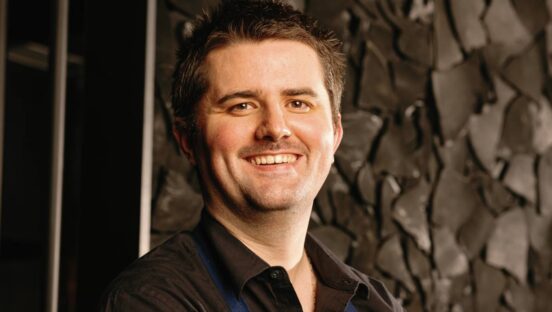

For a long time, Alex Smith’s dream and career aspiration was being a professional musician; his ability to play seven different instruments set him apart and showcased his passion and drive. He tried to make it as a street performer for a while, but quickly realized the inconsistent income wasn’t going to work. So, he did as many musicians do: started washing dishes at a random restaurant in England. And, as the story goes, Smith slowly started falling in love with the restaurant industry. (The dishwasher-to-chef pipeline remains strong, in case anyone was worried.)
“To be honest with you, I guess we’d always had a cooking household, but in terms of doing it professionally, it honestly was a matter of necessity first, and then it became [actually] wanting to do this,” he says.
Now, he’s bringing over a decade of culinary expertise in fine dining, menu development, R&D, and kitchen leadership to Urban Oak in Raleigh, North Carolina, in the dual branded Homewood Suites and Tempo by Hilton Raleigh Downtown hotel.
During the years in between street performing to landing his current role as executive chef, Smith has helmed acclaimed restaurants across the country. As chef de cuisine at Parallax Restaurant in Mammoth Lakes, California, he led kitchen operations from innovative menu design to staff development, ensuring high culinary standards in a high-demand setting. His experience in research and development with Union Square Hospitality Group expanded his expertise in recipe creation, ingredient sourcing, and global culinary collaborations. And at Milk and Roses in Brooklyn, New York, he reimagined the restaurant’s Italian-focused menu, earning recognition in travel guidebooks.
Post-shift drink: I’m sober, so ginger ale
Alt career: Archeologist
Music playing in your kitchen: Peach Pit, King Krule, Mount Kimbie
Trend you’d kill: Taking so many pictures. Just eat the food, it’s gonna get cold
Favorite local restaurant: Himalayan Nepali Cuisine in Cary
“I’ve always been kind of small, independent restaurant-centric, but I’ve been trying to expand my repertoire over the past couple of years by stepping into more of the big business models and everything from the corporate world side of things,” he admits.
Last February, he helped open Urban Oak—inspired by Raleigh’s nickname, the “City of Oaks” for the many oak trees in the area—as the tallest rooftop bar and lounge in the Triangle area (Raleigh, Chapel Hill, and Durham make up the Triangle region, with Research Triangle Park in the middle). The rooftop lounge on the 14th floor features elevated tapas, creative craft cocktails, live music and DJ performances, and sweeping views of downtown Raleigh.


Smith’s goal for Urban Oak is simple: to just be a great neighborhood restaurant, even though it’s also a sophisticated hotel rooftop concept. “I’m not necessarily trying to be a special occasions place. I’d love to be a place where people come once a week, once every two weeks, and just kind of hang out,” he says.
He continues, “The drive with any modern approach to dining is really to fill the need of the third space for people, and to become a meeting place and a communal area; a place to break bread with family and friends, go on a date—we want to be that space for people.”
Smith is consistent with this mindset in the kitchen, where his mantra for his chefs is “don’t overthink it.” Small plates range from classic Spanish tapas like patatas bravas with aji verde and cilantro ($11) to the yellowfin tuna crudo with smoked olive oil, gazpacho, and castelvetrano olives ($20). He also points to the spicy cumin lamb meatballs with mint chutney and sunflower chili crisp ($15) as a great example of balancing innovation, approachability, and value for modern consumers. And, the varying price points allow consumers to stop in and customize their experiences, and ideally drive more loyalty and frequency.
“Our whole dining experience is based around communal eating, so everything is served as ready, served for the table,” he explains. “Of course, we can accommodate if people want a more traditional dining experience, but the biggest aspect of what we do is just have a constant stream of food coming out to the table, so people order pretty big with us in terms of number of items. Most tables will order seven to nine items, and through us sending it as ready, there’s never any awkward downtime of waiting 15-20 minutes for your food to come out, like you will at a lot of other places. We can have food hit the table in a number of minutes, and constantly give people new things to try, new things to share.”
It’s also a balancing act between prioritizing local produce and responsibly sourced proteins with catering to the local palette and bringing a degree of nostalgia with certain flavors, he says.

One of the biggest differences Smith has noticed transitioning from working at smaller independent restaurants to a concept inside a larger hotel chain is “there’s really no such thing as a slow night,” he notes, because there’s always an event or corporate party going on in house, plus the restaurant is just around the corner from the convention center. “There’s a lot more big-picture thinking I’ve found,” he says. “You have to be aware of what’s going on in the city, you have to be aware of what’s going on with the conventions, you have to be aware of groups that you’re hosting in the hotel. So we try to do a really good job of communicating [between] departments based on, what’s our occupancy looking like? There’s a lot of different numbers you have to keep in mind that aren’t just what reservations we have tonight.”
For example, if a group is in town for an awards dinner and they have 50 rooms booked at the hotel, Smith and his team can calculate roughly what time they’ll see an influx of people show up at the bar. “It’s a lot more data-driven than I would say a lot of strictly restaurant concepts are, in a lot of ways,” he adds. “It’s a cool skillset to be able to learn. There’s people here that are a lot better at it than I am, but it’s cool to be able to parse through all that data that you have and try to make your best shot in the dark that you can. It’s good having those kinds of tools so we know, to a degree, what to expect and what to aim for in terms of our operation.”
His previous R&D experience at Union Square Hospitality taught him the importance of scaling and developing standard operating procedures that allow him to execute consistently at higher volumes while retaining quality. “The development world teaches you a lot about how to source ingredients, how to get them consistently,” he says, adding that it also taught him best practices for building strong vendor relationships with open dialogue. “We communicate what we’re looking for, and we trust in them to be able to make recommendations and provide us with what is actually going to apply to what we need, versus just trying to make a sale.”
Smith oversees the entire food program at Urban Oak, from hiring and staffing to training and menu development. He currently has about five team members, but mentions he’s always hiring since they’re getting busier every week.
Another passion for Smith is taking the time to invest in his people and mentoring them. “I’m very pro smaller, tighter teams versus a massive team, if for no other reason than to just reduce variables,” he adds. “With a smaller team, you tend to be able to invest more time in not just getting to know people, but training them and helping people on their individual paths and their career growth direction they’re looking for.”


