


Red Robin’s North Star transformation strategy is getting a makeover.
In its place is the “First Choice” plan, which will see the burger chain become more aggressive around value, in addition to cost-cutting, further investment in restaurant refreshes, and a new refranchising strategy.
CEO Dave Pace, whose tenure began in April, views First Choice as a continuation of Red Robin’s North Star plan, launched in January 2023 by former CEO GJ Hart. Over the past couple of years, Red Robin rebuilt restaurant teams with kitchen and service managers, reduced wait times, introduced flat-top grills, revamped 85 percent of the menu with higher-quality ingredients, leaned into its “bottomless” brand equity, and abandoned deep discounting and virtual brands as part of a greater effort to reduce costs.
But, admittedly, Pace and CFO Todd Wilson say the brand hasn’t made enough progress when it comes to customer traffic.
“There were a lot of things GJ and I were joined at the hip when I was chair and he was CEO, and so the progress made in operations, performance, reinvesting in labor, food quality, culture—those things that delivered the bottom line results at the restaurant level—we want to protect,” Pace says. “But there are things that we want to go further on and we think we need to go quicker and faster and move really aggressively on, which includes how do we drive traffic and then how do we fix restaurants and then related to that, how do we find the funds and proceeds we need to go faster. So it’s, I think if anything, about speed and urgency and how do you fund it.”
READ MORE:
The Next Chapter of Red Robin’s Comeback Starts with Momentum
Red Robin May Close 70 Underperforming Restaurants
Red Robin’s ‘North Star’ Plan Keeps Pointing Upward
The announcement comes as Red Robin expects a 4 percent drop in Q2 same-store sales, modestly below expectations. However, adjusted EBITDA is projected to surpass prior expectations of $13 million to $16 million.
In terms of value, Pace says the First Choice plan isn’t about going back to discounting the whole menu. Instead, the company wants to be more targeted—more rifle shots than blanket promotions. The brand wants to create specific offers that are appealing and encourage guests to visit restaurants.
For customers already visiting, Red Robin hasn’t seen major shifts in their behavior. They’re still ordering appetizers, still buying beverages—they want the full experience. At the same time, the chain recognizes that for some guests, value is very much still about price point.
So Red Robin is looking at ways to offer both the full experience for those who want it, and price-sensitive options for those where cost is the deciding factor.
“We need to be more responsive to the marketplace,” Pace says. “The marketplace is dynamic. Everybody’s facing different challenges at different points in time. It’s clear that the market is now a value-responsive market, and so how we approach and provide value. It’s probably different than it was a year or two ago.”
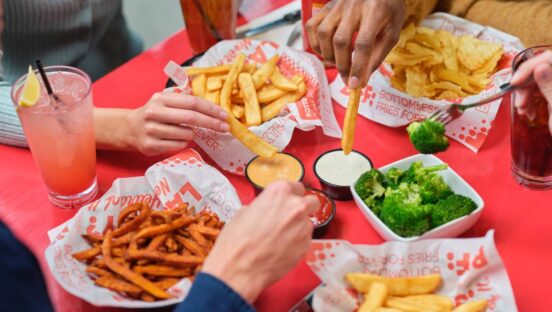
That’s where the new $9.99 Big YUMMM Burger Deal—set to debut on July 21—comes into play, featuring a Red’s Double Tavern Burger, bottomless side, and a beverage. The promotion was tested in a handful of markets through 2024 and the start of 2025. There was a “nice traffic lift,” according to Wilson, giving Red Robin the confidence to move forward on the deal. The chain also didn’t see any significant trade down to the offer or any notable degradation of gross margin per customer.
“I do think there’s still a fair amount of sticker shock in the industry as people saw prices run up really quickly and now go out and say, ‘Gosh, it cost me a lot more to eat out than it used to,'” Pace says. “So how can I find efficient ways to spend my money and get a great experience with great food? I think that’s going to continue. I don’t see that going away right away. I think the companies that respond to that, think about that, provide creative alternatives, are going to excel.”
Pace says Red Robin is committed to “finding money” for these marketing initiatives as well as deferred restaurant maintenance and technology, like handheld devices for waiters, KDS systems, and the continued investment in AI. The brand is working on reducing expenses across the system, refinancing at a lower interest rate, and negotiating with landlords, among other cost-saving measures. The chain began implementing a series of corporate cost reductions that should reduce G&A expenses by approximately $10 million annually.
Core to this pillar is creating cash flow by selling a select number of company-operated restaurants to suitable operators. As of April 20, Red Robin had 491 locations, 90 of which were franchised across 13 states and one Canadian province. Currently, the brand is roughly 80 percent company-owned; after the transactions, Pace says the brand will likely be around 65 to 70 percent company-owned.
Red Robin doesn’t expect any material impact from re-franchising in 2025 since transactions won’t be completed until early 2026.
The CEO emphasizes that this move isn’t a shift to an asset-light model. Red Robin isn’t planning to sell off everything and simply collect franchise fees. Pace describes it as a selective refranchising effort, focused solely on raising capital to deleverage and reinvest in the business.
“We’ve got all these things we want to do, and we want to go quickly,” Pace says. “But you got to pay for it and so how do we do that? So that’s how we arrived at this as a strategic plank for us.”
When it comes to employees, the First Choice plan will keep the managing partner system, a program implemented by the North Star plan to give managers more share and ownership over the profits of their respective stores.
However, the key difference is that Pace wants to shift from an operations-focused culture to a guest-facing one.
“The North Star plan talked about being an operations-oriented company. I think that’s good. I personally say it’s, no, we’re going to be a guest-focused company. We’re going to start with the guests, and then we’re going to do what we have to do to deliver a great guest experience,” Pace says. “Now part of that is supporting the operations team to be able to do that. But I’m not doing this just to make the operator’s job easy. I’m doing this because I think it helps us deliver a great guest experience. So it’s a subtle difference for me, but to me it’s a meaningful one.”


