

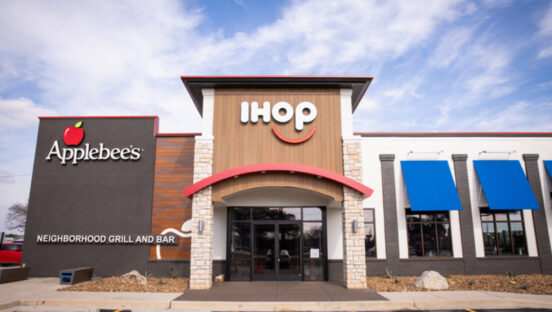

Dine Brands’ co-branded Applebee’s/IHOP concept has progressed beyond a test and is now a core growth engine the industry giant is willing to throw its money behind. And it’s not a short-term strategy; CEO John Peyton projects room for 900 dual-branded units over the next decade.
The dual-brand format uses one shared entrance, with Applebee’s and IHOP each represented in separate seating zones—red for Applebee’s and blue for IHOP. Guests choose either side and order from one streamlined menu organized by daypart, featuring the strongest items from both brands and a few dual-brand exclusives, like the Buffalo Chicken Omelet.
After success with the first U.S. dual-brand in Seguin, Texas where sales nearly tripled compared to the previous IHOP, Dine began expanding the format aggressively. There are currently 15 domestic dual-branded units open alongside 20 international locations, with performance generally ranging from ~1.5x to 2.5x the sales of standalone units. The company expects to have 30 dual-branded restaurants opened or under construction by year-end and 50 more opening in 2026.
“We are the only franchisor with two iconic full-service brands that serve guests across all dayparts, IHOP in the earlier hours of the day and Applebee’s in the later hours,” Peyton said during Dine’s Q3 earnings call. In early dual-brand units, the “off-brand” side is contributing at least 15 percent of daypart sales. “Our thesis is that combining these two complementary daypart brands into one dual-branded restaurant will drive higher sales and create efficiency.”
By merging IHOP’s stronger morning and early-afternoon business and Applebee’s evening and late-night strengths, Dine Brands has created a full-day revenue engine that makes better use of staff, square footage, and equipment. Franchisees, particularly IHOP operators looking to diversify their dayparts, have shown strong interest.
Operationally, the brands still maintain separate branding and menus, but overlap with cross-trained staff and back-of-house investment without diluting brand identity. It’s important to note here the dual-branded model will not replace traditional single-brand development. Instead, it offers a high-ROI option for the right operators and markets, typically suburban areas with a multi-daypart demand and the right demographics to support it. There’s also the opportunity for conversions where operators can refresh older buildings and potentially attract new guests with a new concept at the same time. Peyton noted that roughly half of future dual-brand development could be new builds, with the near-term focus on conversions to speed returns and reduce cost.
As that development strategy gains momentum, its impact is starting to show up in the quarterly numbers. Dine Brands reported $216.2 million in revenue in Q3, up nearly 11 percent year-over-year, driven by stronger company-run restaurant sales and remodel activity. Adjusted EBITDA was $49 million compared to $61.9 million last year, reflecting accelerated investments in remodels and dual-brand conversions—spend Peyton described as intentional and focused on long-term payoff rather than short-term margin preservation.
The ongoing Look & Good remodel program at Applebee’s has delivered improvements in guest frequency and brand perception, while IHOP continues to modernize its dining rooms and streamline back-of-house flow. Approximately 10 percent of company-operated units were temporarily closed during the quarter to support remodels and conversions—a headwind expected to be more pronounced in Q4 and normalize in 2026.
Peyton said franchisees are reporting strong post-remodel sales lifts and an increase in guest frequency. Roughly 80 Applebee’s remodels have been completed to date, and the company expects to surpass the target of 100 by year-end. “There’s more to do and plenty of opportunity ahead, and we’re committed to strengthening the brand’s relevance, sharpening our competitive edge and driving long-term growth,” he added.
READ MORE:
Dine Brands CEO John Peyton on How Applebee’s is Turning NFL Sponsorship into a Brand Powerhouse
Applebee’s Takes the Lead on Refreshing its Footprint
Why IHOP & Applebee’s Are Merging Under One Roof
Applebee’s same-store sales grew 3.1 percent, driven by value-forward menu platforms like The Ultimate Trio sampler, which now accounts for 13.5 percent of transactions, while a tiered entrée strategy is expanding everyday value appeal without overreliance on markdowns. Off-premises volumes grew 9 percent, helped by digital promotions and a more than 260 percent increase in social engagement over the past year.
Though IHOP saw comps decline 1.5 percent, it also achieved its first quarter of positive traffic in several years. “I want to take a moment to fully recognize the significance of IHOP returning to positive traffic comps,” Peyton said “This is a big win, especially in a category where traffic has been challenged for years. Traffic is a core indicator of customer connection and demand.”
IHOP’s traffic momentum began to meaningfully accelerate following the mid-September launch of its Everyday Value platform—an expanded and rebranded version of the House Faves menu now offered all day, seven days a week as part of the brand’s core lineup. It marks the first time IHOP has introduced a value platform as part of its core, all-day lineup.
Early results show positive lifts in both sales and traffic, with value mix reaching roughly 19 percent of sales and elping recapture guests who had reduced breakfast spending or traded down to at-home occasions. Table turn times are now at multi-year lows, Peyton noted, helping the brand avoid clogging during peak breakfast hours.
Indicating the broader trend in casual dining, the word “value” was mentioned nearly 50 times during the earnings call. Peyton noted that while overall spending hasn’t collapsed, guests are making more deliberate choices and managing checks closely—often trading down to lower-priced items that feel like a fair deal. IHOP’s value mix remained at about 19 percent, while Applebee’s value mix slightly increased to about 30 percent in Q3.
“Despite the industry headwinds, our focus on everyday value platforms, operational simplification, and high-impact guest-centric marketing is delivering results,” Peyton said.


