


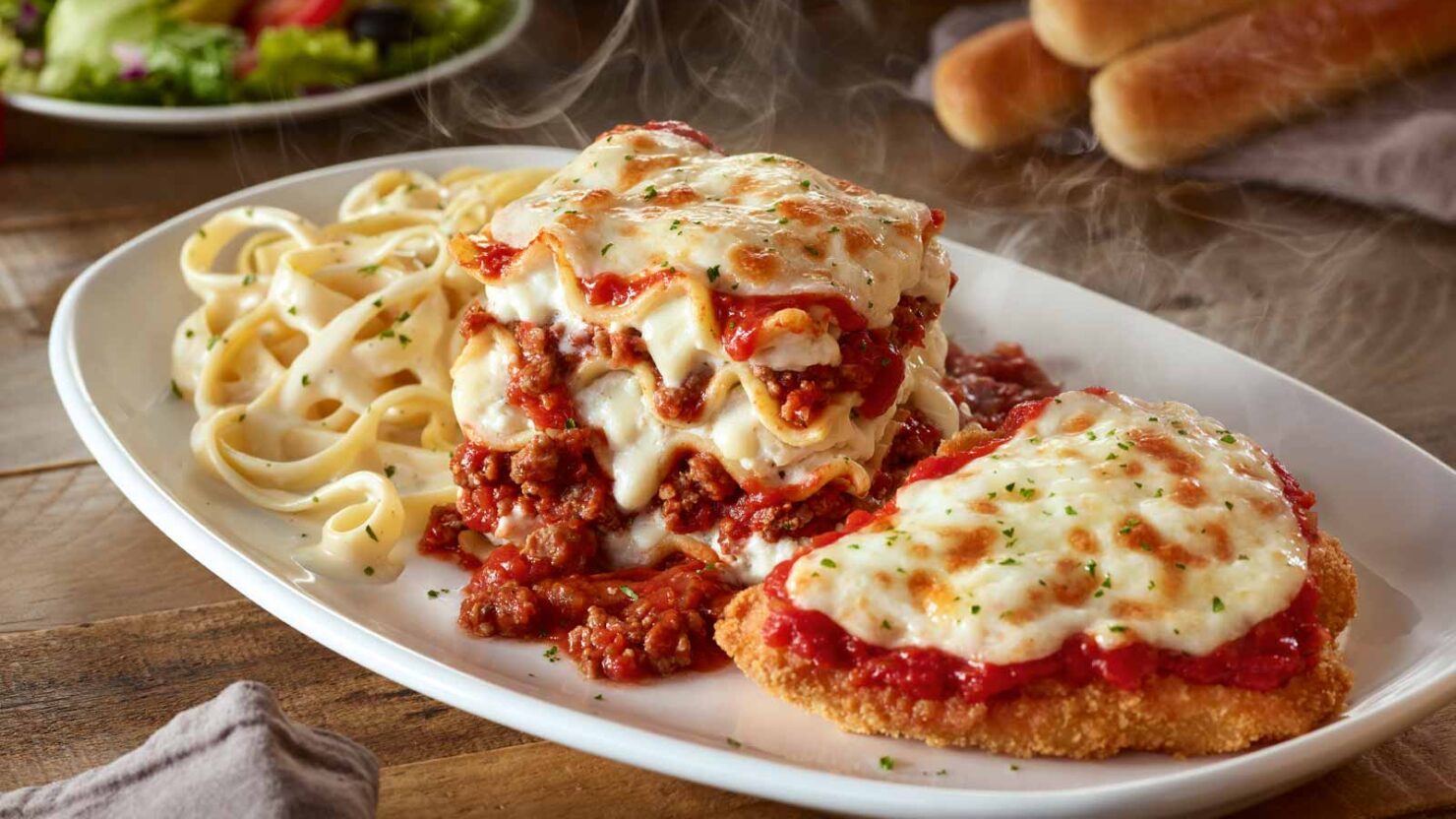
Olive Garden announced Thursday that it’s piloting a delivery partnership with Uber Eats after long resisting the allure of third-party aggregator services.
The multi-year agreement will begin at a handful of restaurants later this year. Customers will be able to order through Olive Garden’s website and app, with delivery handled by Uber. This setup will allow the chain to keep valuable guest data and insights.
After completing the test, the services will expand to Olive Garden’s 900-plus company-operated restaurants by May 2025.
“Uber is a partner we believe shares that vision and can meet our expectations,” Darden CEO Rick Cardenas said in a statement. “Their investment in a custom-integration, commitment to Olive Garden’s first-party delivery growth, and efficiency and speed at a national scale, made this exclusive partnership a clear choice.”
Darden, up to this point, has rejected the rise of third-party delivery for the most part. In 2019, former CEO Gene Lee said “I don’t think we’re missing out on anything.” He also felt the business was more margin destructive than incremental and that tests weren’t compelling enough to launch the service.
Darden offers third-party delivery in a few concepts, but Cardenas told investors in December 2023 that performance in those stores “isn’t significantly different than the ones that don’t have it.” The company even decided to move Ruth’s Chris Steak House away from delivery after it acquired the concept for $715 million.
At the time, Cardenas said the company was confident in its decision to remain out of third-party delivery. He suggested consumers would view the higher rate as Darden’s price, and not as an extra cost for delivery.
Nearly a year later, Cardenas’ tune has changed. He said customers have asked for a delivery option and shown they are willing to pay the higher delivery price for the sake of convenience.
“As we continued to evaluate delivery, it was important for us to find a way to address this guest need state without disrupting the team member or guest experience and without compromising our competitive advantages and simple operating model,” Cardenas said.
Olive Garden’s off-premises growth over the years has impressed the Darden leadership team. In June 2021, Cardenas said the restaurant’s to-go sales were “stickier than we originally thought.” During the brand’s third quarter (three months ending February 24), Olive Garden’s to-go sales mixed around 26 percent, which was nearly the same as the year before.
Olive Garden’s same-store sales dropped 2.9 percent in Q1. However, system sales grew from $2.79 billion to $2.97 billion and segment profit increased slightly from $293 million to $294.7 million.
The Uber move is similar to Domino’s, a fellow quick-service chain that also rejected third-party delivery for several years. That was until last year when the pizza brand agreed to a deal with Uber Eats. In this case, customers can order via Uber’s channels, but they are delivered by uniformed Domino’s drivers.
Sarfraz Maredia, VP of delivery, head of Americas at Uber Eats, said third-party delivery is “increasingly a core expectation for consumers.”
“People also expect a great experience, especially when it’s from a brand they love like Olive Garden, and that doesn’t change whether it’s at the restaurant or at home,” Maredia said in a statement. “We’re confident our teams can deliver on that promise together and continue to grow first-party delivery as a channel.”


