

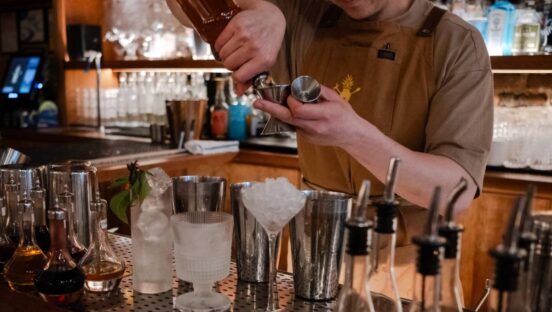

For one night this past spring, Pacific Cocktail Haven (PCH) swapped out its neon sign for one that read Pandan Cocktail Haven—a cheeky nod to a favorite ingredient of owner Kevin Diedrich. Even the bar’s signature pineapple logo was replaced with a pandan leaf. Every cocktail, dish, and dessert served that evening featured the tropical plant, known for its grassy, vanilla-like flavor and wide use in Southeast Asian cuisine.
“The last couple years, I’ve been joking that instead of being called Pacific Cocktail Haven, we should be called Pandan Cocktail Haven, because it’s sort of a lesson in restraint for me not to put pandan in everything,” Diedrich says.
Diedrich is the acclaimed bartender behind both PCH and its sister concept, Kona’s Street Market. He’s also the founder of AAPI Cocktail Week, the reason behind the pandan-themed celebration.
Held in late May, AAPI Cocktail Week has become a magnet for bartenders, chefs, and hospitality pros from around the world. Now in its third year, the Bay Area-based event is more than just a celebration of drinks—it’s a cross-cultural exchange that highlights Asian and Pacific Islander flavors, ingredients, and techniques.
The week features pop-ups, collaborative menus, and immersive experiences that spotlight voices from the Asian and Pacific Islander community in the bar world. Diedrich created the event three years ago in response to a lack of events that showcase and celebrate the city’s beverage industry
“San Francisco historically has been a very strong cocktail town and food town, but we didn’t have festivals or anything like that happening anymore,” he says. “So, I got a bunch of local brands together and said, ‘I want to create Cocktail Week again, but I want to rebrand it culturally with something that makes sense for San Francisco, with the strong culture and heritage that we have.”
The annual event is the latest notch in Diedrich’s storied career. Under his leadership, PCH was named Best American Cocktail Bar at the Tales of the Cocktail Spirited Awards. He was named Best American Bartender in 2020, has been nominated for the award four times, and was recognized as one of the Top U.S. Bar Mentors by the Tales Foundation in 2022. PCH consistently lands on “best bar” lists both nationally and globally and was a finalist for Outstanding Bar from the James Beard Foundation. AAPI Cocktail Week represents a culmination of his 25-year journey in hospitality and an ongoing effort to reconnect with his own cultural identity.
Diedrich didn’t start behind the bar. He began his career in IT, working for tech companies in the Washington, D.C., area. But office life didn’t stick. Inspired by friends in hospitality, he quit and enrolled in a $500 bartending course in Northern Virginia, eventually landing a job at the Ritz-Carlton. He credits the structured environment there with teaching him the foundations of hospitality. At night, he picked up shifts at a nightclub, where he learned speed, efficiency, and how to run a high-volume bar. “The Ritz was my day job, but the nightclub was where I really learned to bartend,” he says.
The turning point came when he stumbled across an old cocktail book. Curious about ingredients like crème de violette and maraschino liqueur, Diedrich asked around—only to find no one in D.C. could tell him much. Research led him to New York and San Francisco, where bars like Milk & Honey and Absinthe were leading a new wave of craft cocktails. Realizing he needed to be part of that movement, Diedrich packed his bags and moved to San Francisco in 2006.
There, he took a role as mixologist at the Ritz-Carlton’s San Francisco property, later working at standout local spots like Michael Mina’s Clock Bar, Bourbon & Branch, and CASK. A brief stint back in D.C. in 2009 saw him open Bourbon Steak as lead bartender. That same year, he moved to New York, working at PDT and Clover Club before ultimately returning to San Francisco to help launch The Burritt Room and later support new bar openings for Kimpton Hotels.
In 2017, Diedrich teamed up with local restaurateurs Andy Chun and Jan Wiginton to open PCH. The idea, Diedrich says, was to create something personal—something that reflected his evolving relationship with his own heritage.
That journey began to take shape when he started thinking more intentionally about how his Filipino roots could show up in his work behind the bar. Adopted by white parents and raised in Northern Virginia alongside a Korean brother, Diedrich says he grew up surrounded by Asian cultures but felt disconnected from his own identity. His parents tried to expose him to cultural touchstones—endearingly but often clumsily, like cooking lumpia and bulgogi “in the whitest way possible.”
It wasn’t until he met chef Francis Ang, the force behind San Francisco’s ABACÁ, that things began to click.
“Francis started introducing me to these Asian and Filipino flavors,” Diedrich says. “I don’t know how to explain it outside of calling it a ‘Ratatouille moment.’ It was like an epiphany of food and flavors, and he was so thoughtful about describing and explaining everything.”
He calls it a “curious experience”—feeling like he was being adopted back into Filipino culture through flavor. That sense of rediscovery inspired the vision behind PCH: a “love letter to the Asian Pacific,” built on both personal history and professional training.
“I was classically trained, and that’s always the roadmap for me in terms of creating new cocktails,” he says. “So, at PCH, we’re using Asian and Pacific ingredients but then plugging them into those familiar, classic and contemporary cocktails.”
That approach is clear in drinks like the Leeward Negroni, which keeps the cocktail’s traditional structure but adds tropical depth through pandan cordial and Campari fat-washed with coconut oil. Another standout, the Thrilla in Manila, blends calamansi, shiso, li-hing mui, coconut cream, bourbon, and absinthe for a creamy, savory, and refreshingly complex twist.
Diedrich has watched the cocktail world change dramatically over the last decade—especially in how bartenders learn and share knowledge. Ten years ago, accessing new techniques often meant knowing someone, or traveling to a specific bar. Now, technology and social media have opened the floodgates. What used to be a slow, insider-driven process is now open-source, he says, with education from brands, tutorials, and Instagram putting advanced techniques within easy reach.
Diedrich says more bartenders are leaning into cultural identity through cocktails, a shift powered by new tools that allow for cleaner, more refined uses of traditional ingredients. In San Francisco, he sees Indian restaurants experimenting with spice-forward drinks, though he jokes his palate can’t handle the heat—“thanks mom and dad.” He also sees ingredients like banana and other fruits gaining momentum, thanks to advancements in beverage technology.
“Use Pectinex with banana, throw it through a Thermomix, and now you’re making banana water,” he says. “You’re no longer blending and having this chunky cocktail, or trying to infuse banana into a spirit and making it murky and oily. You have all of these chemicals and enzymes and all of this technology to make these elevated cocktails and use almost any citrus out there.”
That same innovation is opening doors for ingredients like pandan, ube, lychee, rambutan, and jackfruit—flavors tied to Asian and Pacific cultures, and ones Diedrich sees gaining traction on menus worldwide. “These ingredients are cultural for me,” he says. “They help me find my identity within my community and within my family, and they give me a way to share all of that with other people.”


