
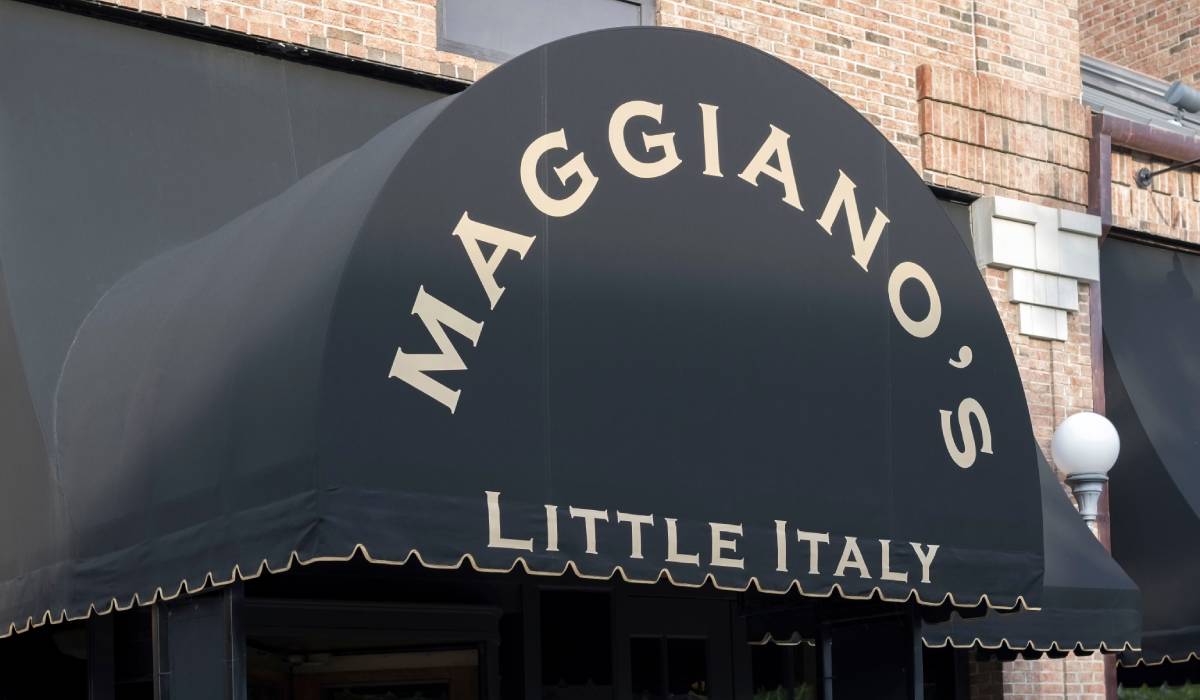
Brinker International isn’t adding another restaurant brand to its portfolio—at least not yet. But the company is actively building toward that possibility, and Maggiano’s is at the center of the plan.
During its Q3 earnings call, leadership made clear that the Italian casual-dining concept is more than just a turnaround story. It’s a proving ground—one that could determine whether Brinker is ready to expand beyond its current two-brand system.
“Part of the Maggiano’s turnaround is also just unifying the system so that we could be ready for a third brand should we be able to turn around Maggiano’s,” CEO Kevin Hochman said.
That long-term ambition is shaping how the company approaches the brand today. Rather than viewing Maggiano’s purely through a financial lens, Brinker is also using it to test whether its operating model can scale across multiple concepts, similar to larger multi-brand restaurant companies.
For instance, one of the more significant changes underway is the integration of Maggiano’s into Brinker’s technology infrastructure, including the adoption of Chili’s kitchen display system.
Standardizing systems across concepts is a critical step in building a platform that could eventually support additional brands. It reduces complexity, improves efficiency, and allows leadership teams to operate more seamlessly across multiple chains.
That kind of scalability is a prerequisite to pursuing any new acquisition or concept, according to Hochman.
For now, however, leadership is taking measured steps. The company has no immediate plans to pursue a third brand until it proves it can successfully stabilize and grow Maggiano’s.
“I would caution us from trying to get a third brand,” Hochman said. “We have no business doing that until we can prove that we can handle our second brand.”
That caution comes from the opportunity and the challenge ahead. Maggiano’s currently represents a relatively small portion of Brinker’s overall business—about 8 percent of sales and a low single-digit percentage of profit—but leadership sees meaningful upside if the concept can be repositioned effectively.
“We are continuing to make progress in its turnaround,” Hochman said.
The early signs are incremental but encouraging. Adjusting for calendar shifts and weather disruptions, the brand showed sequential improvement in traffic and comparable sales during the quarter.
Maggiano’s same-store sales fell 4.6 percent in Q3, fueled by 5.2 percent pricing and 0.6 percent menu mix, offset by negative 10.4 percent traffic.
Operationally, the company has focused on restoring core elements of the Maggiano’s experience. This effort includes bringing back legacy menu items and reinforcing the brand’s value proposition.
“Customers are noticing more abundant portions, more generous family-style, and the return of classic Maggiano’s dishes like eggplant parm and Gigi’s butter cake,” Hochman said.
Value perception is also beginning to improve.
Even so, leadership acknowledged there is still significant work ahead, particularly on the operational side. Service execution and dine-in efficiency remain key focus areas as the brand looks to enhance the guest experience.
That journey toward operational fundamentals mirrors the playbook Brinker has used for Chili’s, including prioritizing food, service, and atmosphere before layering on demand-driving initiatives like marketing.
However, with 53 locations, leadership does not expect to rely heavily on national advertising campaigns. Instead, the focus is on enhancing the in-restaurant experience.
“We’ve got to improve food service and atmosphere at Maggiano’s if we want to grow traffic over time,” Hochman said.
The company said progress will be measured quarter by quarter, with a focus on steady improvement rather than rapid change.
Still, leadership remains confident in the long-term potential of the brand, pointing to what it sees as significant whitespace for growth once the fundamentals are fully in place.
“This turnaround, like the Chili’s turnaround, will take time,” Hochman said. “But as long as we focus on important areas of food service and atmosphere and make progress every quarter, I’m confident we’ll return this business to growth.”