
Red Robin is still posting negative same-store sales, but the casual-dining chain believes the more important story is happening underneath the surface.
Traffic trends are improving. Restaurant-level margins are climbing. Value offerings are resonating without collapsing profitability. And after years of operational inconsistency, executives said the company is finally beginning to build a more stable foundation for recovery.
The company reported first-quarter same-store sales decline of 0.6 percent, including a 1 percent increase in average check and a 1.6 percent traffic decrease. While negative, Red Robin said the traffic result marked its strongest performance since the first quarter of 2023 and continued a sequential improvement trend from late last year. Restaurant-level operating margin improved 50 basis points to 14.8 percent, the chain’s highest first-quarter margin in five years.
CEO David Pace said the quarter was further validation that the company’s “First Choice” turnaround strategy is beginning to gain traction.
READ MORE:
Red Robin Builds Stability as Traffic, Margins, and Guest Engagement Improve
How Red Robin is Building a Culture of Winning Again
Red Robin’s Low-Cost Burger Play Lures Back Guests
One of the biggest efforts is Red Robin’s Big Yummm value platform, which has become the company’s primary traffic-driving engine during a time when consumers remain heavily focused on affordability. Unlike many chains leaning aggressively into discounting, Red Robin said it is attempting to balance value with innovation and higher-end offerings through a barbell menu strategy.
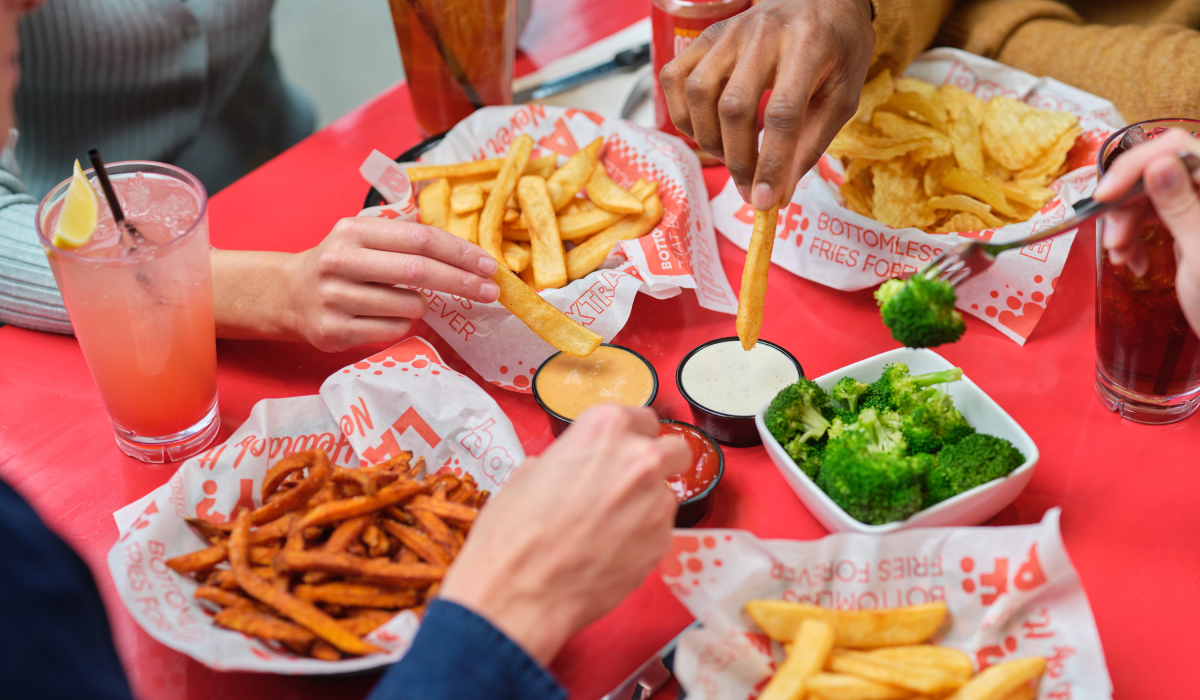
The expanded Big Yummm lineup now includes six meal options ranging from $9.99 to $16.99, spanning burgers, Donatos pizza, wraps, and chicken sandwiches, all bundled with the chain’s signature bottomless sides and beverages. The offerings are currently mixing above 13 percent, aligning with internal expectations and helping strengthen relevance with value-seeking consumers.
According to Pace, the platform is generating traffic without forcing the company into a perpetual discount cycle.

Early bird ends soon for QSR Evolution Conference registration! Sign up here today.
“Our Big Yummm value platform continues to resonate with guests with high satisfaction scores, and we’re seeing strong results across the system,” he said.
Red Robin’s 1 percent increase in average check consisted of a 3.1 percent rise in menu price, offset by a 2.1 percent decrease in mix and discounts, driven largely by the impact of Big Yummm.
Pace emphasized that Red Robin’s strategy is not simply about being cheap. Instead, he said the company is attempting to deliver value and preserve the full-service experience guests expect from the brand.
“The consumer is obviously interested in value messaging and value offering across the category these days,” Pace said. “But that doesn’t mean we’re not going to continue to innovate with new products.”
That innovation push comes as the company tries to regain frequency. Pace pointed toward the recent launch of Towering Sliders, which he said generated record-setting menu satisfaction scores and drove incremental check growth shortly after rollout. Red Robin also introduced a revamped menu earlier this year that paired value-focused offerings with more premium products in an effort to widen guest appeal.
The strategy appears to be helping narrow Red Robin’s traffic gap relative to the casual-dining industry. Traffic trends improved sequentially from Q4 and continued outperforming industry benchmarks tracked by Black Box Intelligence.
Marketing investment also played a role. Interim CFO Chris Meyer said Red Robin increased marketing spend year-over-year and plans to continue doing so throughout 2026 as the company leans harder into its targeted “First Choice” marketing approach.
The strategy uses localized messaging tailored to competitive conditions within individual trade areas rather than mass-market campaigns. The effort is improving engagement and marketing efficiency and helping drive frequency.
“We’re seeing the benefits of this more precise, disciplined approach in our traffic performance,” Pace said.
Restaurant-level operating margin increased despite ongoing inflationary pressures and declining traffic. Much of the improvement came from labor efficiency initiatives, which drove approximately 130 basis points of year-over-year savings during the quarter.
Labor as a percentage of sales fell to 35.7 percent, the company’s lowest first-quarter labor rate in three years. Executives credited tighter operational discipline, managing partner accountability, and technology adoption for much of the progress.
“What’s particularly encouraging is that we are achieving these efficiency gains without compromising the guest experience,” Pace said.
The company believes technology and AI tools will help balance labor productivity with service standards.
Last fall, Red Robin rolled out an enterprise version of ChatGPT AI tools across the organization. Pace said managing partners are already using the technology to optimize labor scheduling, manage food costs, and improve operational decision-making at the restaurant level. The chain is also continuing technology upgrades inside restaurants. Red Robin has begun replacing handheld server devices and plans to introduce upgraded Ziosk tabletop devices later this year. Leadership believes the systems will improve order accuracy, speed of service, and server efficiency.
Pace described the upgrades as part of an effort to restore what he called Red Robin’s historical “gift of time” advantage.
Operational improvements are extending into the physical restaurants themselves. Through its “Fix Restaurants” initiative, Red Robin is rolling out light-touch refreshes focused on customer-facing elements designed to improve the dining environment without requiring full remodel investments. The company expects the first completed refresh markets by the end of June.
At the same time, Red Robin is working to stabilize its balance sheet through a tactical refranchising initiative. Pace said the company remains in advanced discussions with multiple prospective franchise groups interested in acquiring restaurants.
Importantly, executives said interest levels from franchisees have strengthened as operational trends improve.
“These are sophisticated operators who recognize the operational progress we’ve made and see the opportunity that our First Choice strategy creates,” Pace said.
The company plans to use proceeds from any refranchising transactions primarily to reduce debt and strengthen liquidity. Red Robin ended the quarter with $24 million in cash and equivalents alongside $17 million of available borrowing capacity under its revolving credit line.
The company is also rationalizing its footprint. Red Robin closed six restaurants during the quarter and expects approximately 20 closures across 2026. Leadership said the closures should have a relatively neutral impact on restaurant-level operating profit and remove roughly $40 million in annualized sales volume.
Even with improving trends, executives remain realistic about the environment facing consumers and the casual-dining sector overall.
Commodity inflation remains elevated around beef and dairy, and consumers continue scrutinizing discretionary spending. Red Robin maintained its full-year outlook, projecting same-store sales growth between 0.5 percent and 1.5 percent alongside adjusted EBITDA between $70 million and $73 million.
Still, the company believes it is finally building momentum after several years of instability.
As Pace approaches his one-year anniversary as CEO, he said the biggest shift inside the organization has been cultural.
“What stands out most for me is a growing sense of ownership and pride across our restaurants,” he said. “Our team members are not simply executing initiatives. They’re owning the challenge, putting guests at the front of everything we do, and actively contributing ideas that have improved operations and enhanced the guest experience.”