
Tony Pham’s family first entered the restaurant world in 2006 with a 900-square-foot Vietnamese pho restaurant in Connecticut that he affectionately describes as a “hidden gem.” At the time, Pham was in nursing school and had no intention of pursuing a career in restaurants. But as the oldest son of first-generation immigrant parents, he felt a natural obligation to help.
That sense of responsibility had been a part of his life since childhood, from translating labels in the grocery store to driving his mother to a restaurant where she staged to learn new techniques. Now, it extended to helping his parents establish their own business.
“We didn’t know anything about the restaurant industry,” Pham says. “All we knew how to do was cook, and my mom made me do the rest. I had to start an LLC. I had to figure out what the front of the house was about. I had to figure out the menus. Every little detail about the restaurant industry was thrown in my lap.”
He describes helping to open and run the restaurant as full of “blood, sweat and tears.” The kitchen, he recalls, was “like a food truck, probably smaller.” Things could get tense on busy nights with the family working shoulder-to-shoulder in a confined space. Despite the struggles, the experience proved foundational. Pham learned not just the mechanics of running a restaurant but also the nuances of building a small business. And he discovered a deeper love for food, enough that he ultimately gave up on becoming a nurse and decided to carve out a career in the restaurant industry.
He also credits his growing culinary passion to the “rock star status” of chefs like Anthony Bourdain and David Chang when he came of age. And while he deeply admired his parents and their work, the intensity of working alongside them in such tight quarters eventually spurred him to strike it out on his own.
At the time, ramen was just beginning to gain traction in the U.S. Pham spent months researching Connecticut towns for a potential location, ultimately settling on Fairfield for its college-town energy and proximity to both New York City and Boston. But before securing real estate, he recognized that he needed to develop authentic ramen skills. His background in pho and Vietnamese cuisine wasn’t enough.
To build his expertise, Pham traveled to New York City to train with chef Shigetoshi Nakamura, a celebrated Japanese ramen master behind restaurants like Ramen Nakamura and Slurpeak. He returned to his family’s restaurant after honing his craft, combining his newfound ramen techniques with his Vietnamese culinary roots. The result was a unique style that became the foundation for his own restaurant concept.
Pham opened the first Mecha Noodle Bar location in 2013, taking much of what he learned from his parents’ Vietnamese restaurant and layering in other influences, namely Japanese, Korean, and Laotian dishes. Today the restaurant serves Asian-American comfort food with a focus on rich, broth-based pho and ramen, alongside street food like bao buns, dumplings, egg rolls, and fried rice, plus playful drinks and boozy boba.
“I wanted to create a place that wasn’t just about stellar food, but also had a cool playlist and ambiance and an emphasis on cocktails,” he says, adding that many “hidden gem” ethnic restaurants excel in food but often overlook the environment and other aspects of the guest experience.
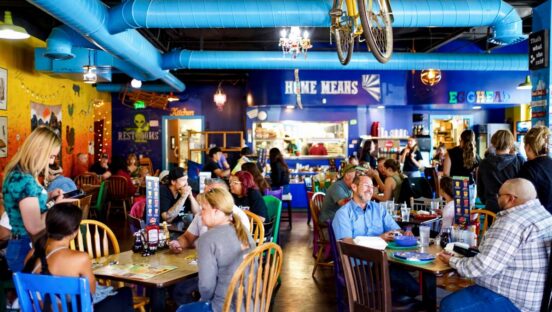
Pham was deliberate about putting his own stamp on Mecha’s look and feel, drawing on his upbringing in Connecticut during the 1990s. Restaurant playlists lean heavily on the hip-hop and R&B he grew up listening to, and employees were encouraged to express themselves through casual, personalized attire rather than strict uniforms. The interior has a distinctive look as well, thanks to ceiling-mounted two-by-fours that evoke hanging noodles and appear at every location today.
Mecha Noodle Bar’s early expansion beyond its first spot kicked off not long after the first restaurant opened, when Pham teamed up with his childhood friend Rich Reyes, also a son of immigrant parents, who joined as a partner with the second location. Early growth after that focused on Connecticut, with locations in Norwalk, Stamford, and New Haven.
By 2020, the brand was ready to push outside its home state. Plans were in motion to enter the Boston market, but nothing had been finalized yet when the pandemic hit.
“We were like, ‘OK, either we hide and wait this thing out, or we try to make a deal during COVID,’ which is risky because no one knew what was going on at the time,” Pham says.
Ultimately, they pressed forward and secured two deals: one in Boston’s waterfront Seaport neighborhood and another in the nearby suburb of Brookline. A few years later, in 2024, Mecha made an even bigger leap beyond its home turf, opening restaurants in Denver, Washington, D.C., and Columbus, Ohio, all outside its Northeast base and across different time zones.
“They were all hot markets with good real estate and good deals,” Pham says, pointing to the “fall forward” mentality he and Reyes have adopted over the years. “We said, ‘let’s try it.’ We could do one restaurant a year, or we could take this leap. So, we said, ‘Let’s take another risk. What are our limits? How much can we grow?’”
The expansion, he notes, came with significant challenges, particularly when it came to marketing and public relations. Introducing an unfamiliar brand to entirely new regions required substantial energy and investment. After closing the Ohio location last year, Mecha opened a new restaurant in Philadelphia, keeping its total footprint steady at 11 units.
Looking back, Pham says the most meaningful moment in Mecha’s journey came in the early days, when the concept was still young and its footprint was limited to Connecticut. In 2015, he and Reyes founded Eat Justice, committing 50 cents from every ramen bowl sold to employee-selected charities.
Since then, the “why” behind Mecha’s growth—using the restaurant as a vehicle to make a positive impact—has always been as important as the business itself. That philosophy has shaped how the brand has grown, including its decision to remain self-funded and avoid private equity or outside investment.
“Once I understood the ‘why,’ it made me put my head down and grow in a thoughtful way,” he says. “We aren’t going to just open up as many units as we can like private equity would. It isn’t about making a ton of money. It’s about growing so we can scale Eat Justice.”
Staying connected to that “why” has led to deep personal reflection. Pham attended a leadership retreat in Costa Rica that involved the use of ayahuasca, a plant-based medicinal brew traditionally used by Amazonian peoples in spiritual ceremonies. In that setting, he meditated on the next chapter of his life and sought clarity around his broader purpose. He recalls experiencing a profound sense of connection and seeing all sentient beings as grains of sand with their energies intertwined.
During the experience, Pham says he saw the suffering of others—particularly Vietnamese people, past and present—and received a clear message to “go back to Vietnam.” A year later, he followed through, partnering with Sunflower Mission, an organization focused on building schools and supporting education for children in his parent’s home country. Through a volunteer work camp, he helped construct schools and immerse himself in local communities.
That sense of purpose is inseparable from his family’s story. Pham’s parents arrived in the U.S. as teenagers without knowing the language, and his father relied on nonprofit support after landing in the country in the 1980s.
Pham says Mecha, Eat Justice, and even his own life feel “a wind gust away from not being here,” given the perilous journey his parents endured and the difficulty of building a stable, middle-class life. His business and philanthropic efforts are ways to honor their sacrifices and acknowledge the opportunities their resilience made possible.
Looking ahead, Pham says 2026 will be a “big year” for Mecha Noodle Bar, but not because of new restaurant openings. Instead, the focus will be on “remembering and rebuilding.” That includes refining internal operations, strengthening training systems, listening more closely to staff feedback, updating the company’s learning management system, and emphasizing team development and retention. As always, the brand’s philanthropic program will remain a central priority.
Since its founding, Eat Justice has raised more than $1 million, including over $150,000 in a single campaign for Sunflower Mission. Pham says that was enough to build a school and provide scholarships in Vietnam.
“That’s what makes the days of being tired and exhausted from work and all the headaches way better,” he says. “It makes it worth it. It has nothing to do with profits and everything to do with the relationships I’ve built through Eat Justice and the moments of silence and gratitude when I realize that this is all such a privilege.”