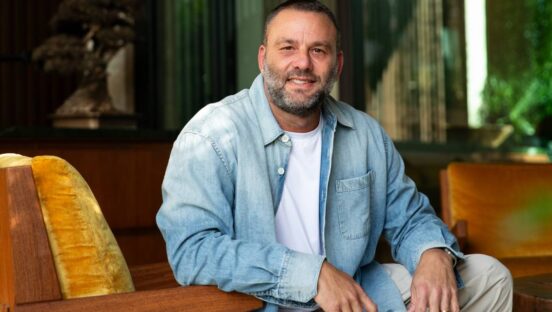

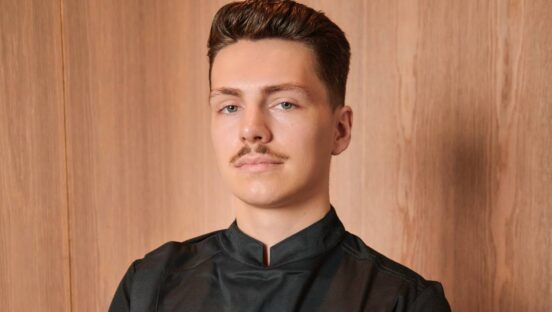
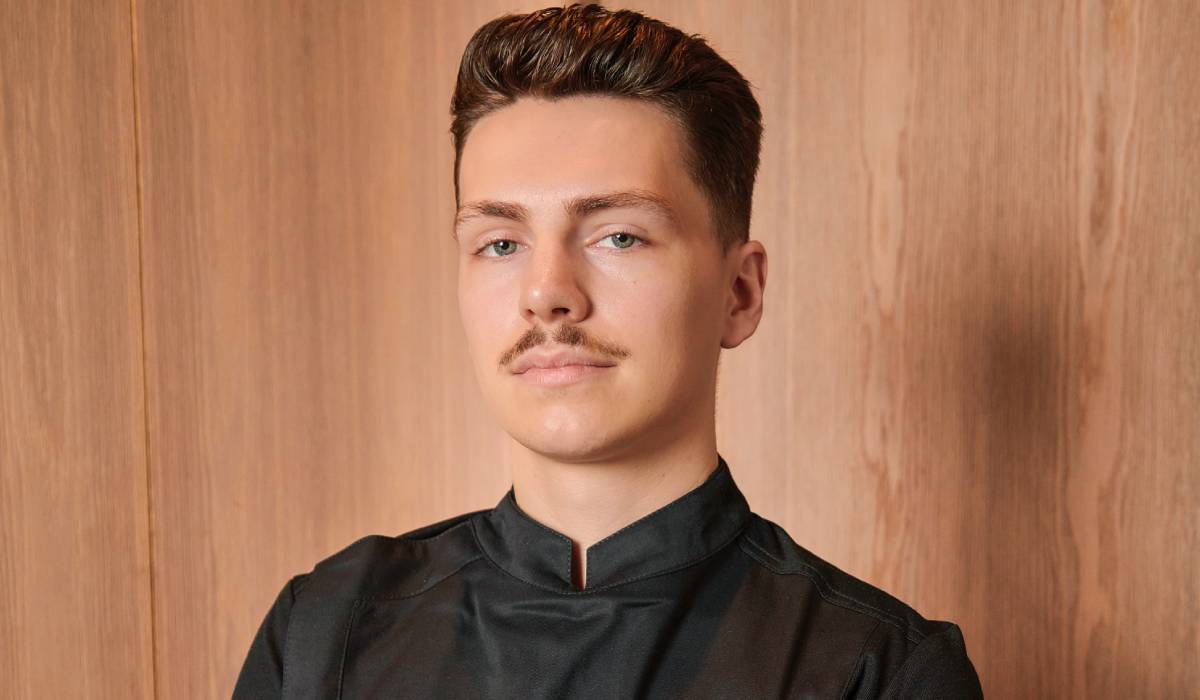
Growing up fishing in Michigan, Logan McNeil never thought he’d become a chef de cuisine at a Michelin-starred restaurant by the age of 23. Up until freshman year of high school, he thought he wanted to become a robotics engineer, until one day he took a hard pivot and decided he wanted to pursue a professional culinary career. “I got to a certain point where I realized I wouldn’t enjoy [engineering] everyday if I had it for a job, and I knew I wanted a job I was going to be passionate about and really love,” he recalls. “Just like the flip of a switch, I switched to cooking, and I’ve never doubted it since.”
In culinary school, he recalls learning a crucial lesson about the importance of knowing your audience when he was challenged to a burger cook-off with a classmate. “I’ve never wanted to turn down a competition, and I felt like I had the win in the bag, so I happily took him on,” he says. “One thing I overlooked was that the judge for this very unofficial cook-off was a very basic cheeseburger kind of guy, and I went all out and made a very non-basic cheeseburger, and I lost. I was shocked. And this guy that I was doing this cook-off with, he looked to me and said, ‘You’ve got to know your audience,’ and that little piece I use now when I create menus.”
He adds, “I look at it from a selfless point of view … of course, I create from what I’m passionate about, and try to tell my story through food. But I always, always, always have the guests in mind, because they’re the ones that we’re cooking for.”
McNeil is now the newly appointed chef de cuisine at Miami’s Michelin-starred Tambourine Room by Tristan Brandt, located in the beachfront Carillon Miami Wellness Resort. World-renowned chef Brandt made history as the youngest chef in Germany to lead a two-star Michelin kitchen, and today passes on his knowledge as a mentor for young talent like McNeil while simultaneously organizing top-tier international festivals like the Waldhaus Flims Festival of the Arts in Flims, Switzerland, and the Pfälzer Gourmet Festival in Deidesheim, Germany.
- Favorite casual Miami eateries? Cecile Bakery + Cafe for brunch, or a smashburger from Celia’s in Wynwood
- Alt-career? Robotics engineer; chefs are like engineers, just with food and ingredients
- Go-to spice/herb at the moment? At home, smoked paprika; at the restaurant, fresh dill
- Hobbies? Fishing—I grew up on a lake in Michigan. I love fishing down here when I can
- Secret guilty pleasure snack? Candy—Sour Patch Kids, Starbursts
- Favorite foodie city to visit? New York
Brandt made his U.S. debut in December 2022 with the launch of Tambourine Room by Tristan Brandt, an evolution of the original concept which opened in 1958 as a space for cocktails and conversation amongst jazz legends. Nearly 68 years later, Brandt and McNeil continue to evolve the iconic venue through a reimagined lens of contemporary fine dining.
Meanwhile, McNeil brings a proven track record from Top Chef Jeremy Ford’s Stubborn Seed, where he joined as a line cook and rose to executive chef by 22. McNeil played a pivotal role in earning the restaurant its Michelin Star and Green Star for sustainability, and spearheaded innovative composting efforts that offset more than 11,000 pounds of food waste. “Starting there at 19, I was at first in disbelief [that] I was actually able to work there,” he admits. “Throughout my time there—just being a sponge and really just working hard and being dedicated—I was able to learn so much, not even just from Jeremy, but everyone that worked there. It’s a very collaborative kitchen, and that’s where I learned how to create and I think got my culinary voice.”
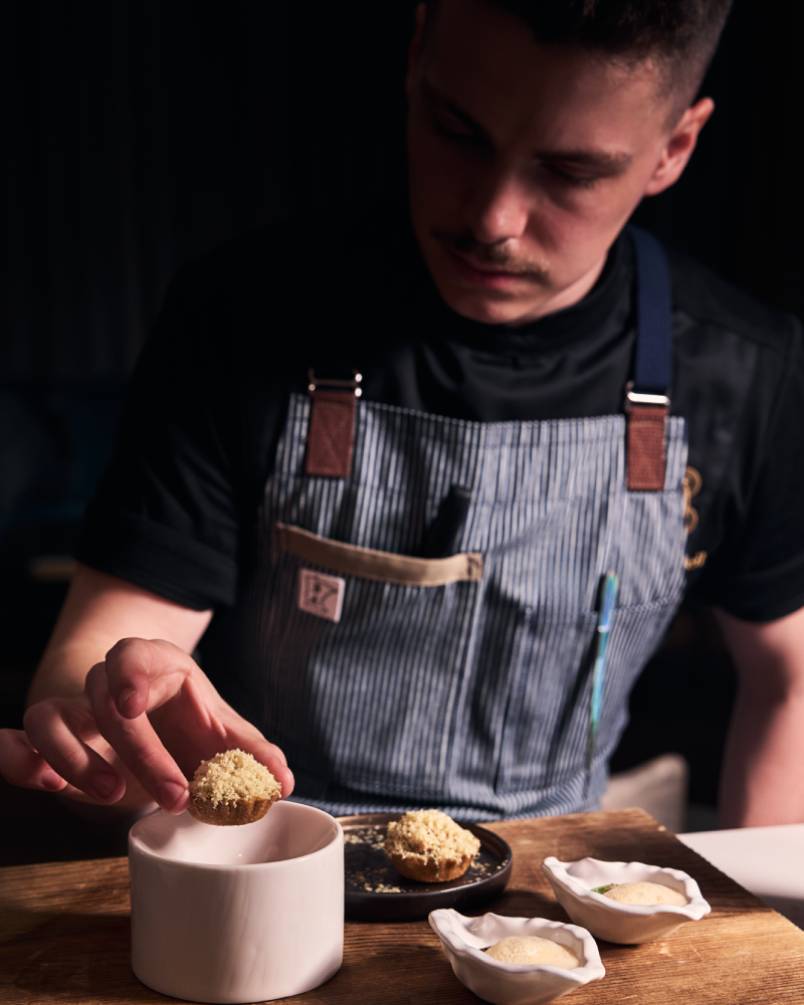
At Tambourine Room, McNeil now collaborates closely with Brandt, blending French technique with refined Asian influences to create a seven-course tasting menu, with an emphasis on sustainable practices and mindful, ethical sourcing. The tasting menu is guided by a philosophy of honoring land, sea, and season, and each course is presented by the chef creating an immersive, narrative-driven dining experience filled with bold flavors, delicate artistry, and unexpected moments.
The restaurant is anchored by its focus on providing an excellent guest experience—an evolution of the lesson McNeil learned in culinary school. “Our main goal is to achieve a connection with the guests,” he adds. “If we can achieve that connection on an emotional level, which I believe can be done through storytelling, then we’ve probably created an experience that they’ll never forget.”
A few notable dishes from the fall tasting menu: Porcelet & Caviar with rose apple, yukon espuma, and potato chicharron; Key Largo Snapper with kombu jalapeño sofrito, coal fired zucchini, and coconut curry beurre blanc; and Venison Tenderloin with confit celeriac.
As Tambourine Room approaches the winter seasons, McNeil is preparing for a significant menu transformation that highlights South Florida’s agricultural bounty. In November, approximately 95 percent of the restaurant’s produce comes from organic farms in the region.
Unlike Florida’s challenging summer growing season, characterized by intense heat, the fall and winter months offer an abundance of fresh, local ingredients. Having personally visited many of these farms, McNeil is passionate about showcasing the region’s agricultural diversity. This approach not only supports local farmers, but also allows the chef to help craft a menu that truly reflects the terroir of South Florida, making it his favorite time of year for culinary creativity.
For McNeil, ingredient sourcing is as much about ethics as it is about flavor—a passion and authenticity that shines through while talking to guests. “I can regurgitate words all night long to the guests; I think it only really has meaning if I am passionate about it as well,” he says. “Any stories I tell about ingredients or vendors or how things were grown or harvested are stories that I’ve heard from the vendors themselves, or maybe even just things that I’ve been to the farms and I’ve seen the process, and I myself have taken the time to learn about it, hands-on, first-person, and become equally as passionate about it. So then when I speak to the guests, it’s not just words that I’ve rehearsed, but it’s something I’m actually excited and passionate about and love.”
That focus extends to the sea as well. McNeil and Brandt source fresh Florida oysters from Everglades Oysters farm, a 74-acre regenerative farm pioneering Gulf restoration through a circular shell recycling program.
The restaurant’s sustainability ethos is woven into every corner of its operation, from composting to oil alternatives. They use sustainable, fermented sugarcane oils from Zero Acre Farms, which helps eliminate seed oils, which are linked to deforestation, McNeil notes, and it allows them to cook with a cleaner product that’s better for the planet and guests. “The oil that they actually produce through their process is one of the healthiest oils that there is to consume. It really doesn’t have negative effects, yet it still yields very high-quality oil, very high smoke point for cooking, very neutral flavor. It’s very versatile in our kitchen,” he explains.
While McNeil’s attention to sourcing is deeply intentional, his philosophy is far from performative. “People just have come to realize that as chefs, we take so much life from the earth, because everything we use to cook was once living, and what are we doing to give back?”
In many ways, McNeil sees Tambourine Room as a reflection of where fine dining is headed in the future—a balance of artistry, ethics, and emotion. He adds, “I think sustainability and ethics are definitely trending right now, but I don’t think that’s going away. I think that’ll just be the new way of responsible cooking, and my hope is that we won’t stand out for doing it in the near future. That’ll just be a normal thing, because it truly is a better way to go about what we do as a craft.”