
Nine percent of full-service restaurants nationwide could close this year, according to Black Box Intelligence, as operators continue to navigate a volatile macroeconomic environment.
The firm classified these restaurants as “at risk,” meaning that in 2025 they lost more than 30 percent of their highest annual sales level recorded since 2019.

Black Box noted that unit growth in the casual-dining segment has declined 3.3 percent since 2022.
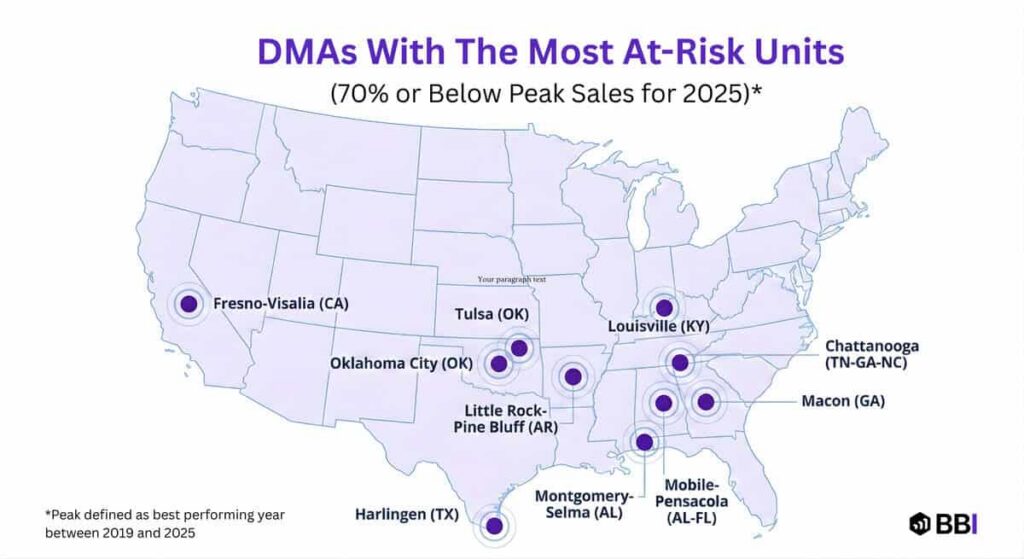
Here are geographies with the highest concentration of restaurants that have lost more than 30 percent of their peak sales and are set up for closures:
- West: Fresno-Visalia (California).
- Southwest: Oklahoma City and Tulsa (Oklahoma) and Harlingen (Texas).
- Southeast/Mid-South: Little Rock-Pine Bluff (Arkansas), Louisville (Kentucky), Chattanooga (Tennessee/Georgia/North Carolina), Macon (Georgia), Montgomery-Selma (Alabama), and Mobile-Pensacola (Alabama-Florida).
Black Box explained that many of these trade areas have high diabetes rates, leading to high GLP-1 adoption and a resulting decline in restaurant demand.
Victor Fernandez, Black Box’s VP of insights and knowledge, said cumulative inflation has increased costs by one-third since 2019. These growing expenses make it “virtually impossible for a unit to remain viable after losing 30 percent or more of its peak sales,” the analyst added.
And for the 3 percent of full-service locations that lost more than 50 percent of peak sales in 2025, “the question for 2026 isn’t if they will close, but when,” Fernandez said.
Quick-service locations are faring better. Only 4 percent are at risk, as QSR and fast-casual segments saw net unit growth of 5.8 percent and 15.5 percent, respectively, since 2022.
It doesn’t help that consumers have tightened their wallets. From a survey of 1,340 U.S. adults, YouGov found that 28 percent expect their finances to worsen in 2026 while 34 percent expect improvement. Fifty-three percent set a budget this year, up from 46 percent in 2025. More importantly, two-thirds of those foreseeing financial decline plan to cut back on dining out.
Fernandez recommended that restaurateurs get ahead of matters by actively cleaning up their portfolio instead of closing reactively. Strategic shutdowns could lead to profitable sales transfers to nearby locations.
“The silver lining here is that a leaner portfolio often becomes a stronger one,” Fernandez said. “When a brand stops subsidizing its bottom 10% of units, it can reallocate capital, management attention, and marketing spend to the units with the highest growth potential. This ‘traffic transfer’ effect is a powerful tool for survival in 2026.”
This philosophy has been used by several large restaurant chains. The likes of TGI Fridays, Red Lobster, Denny’s, and others have shuttered well over 100 underperforming restaurants in recent years as a way to realign their footprints.
Fernandez also said operators should judge their unit-level performance against local competitors instead of looking at internal historical data.
“If a unit is losing traffic while the local market is growing, the issue is execution, not the economy. However, if the market is saturated and traffic is down across the board, operators should consider strategic closures to consolidate volume into their top-performing sites,” Fernandez said.
Additionally, the Black Box executive said closures present an opportunity for surrounding restaurants to scoop up leftover traffic and grow market share. But that’s only if they have a favorable value proposition, execution, sentiment scores, and employee stability.