
Editor’s note: This is the third in a multi-part series that will look into the state of full-service restaurants for the coming year. The first part explored finances. The second, labor. The next part will dive into delivery and takeout.
Next up in our State of the Industry series is inventory and menu management. There are really two sub-topics that defined 2025 and carry over into this year—tariffs and inflation. Those ever-buzzing pressures set the stage last year for restaurants to raise prices yet again.
Before getting into TouchBistro’s survey, if you look at recent (November) Census Bureau data, restaurant sales gained a bit after declining in October. Rising menu prices drove much of the nominal gains, as they have for months. Yet restaurants also generated positive figures on an inflation-adjusted basis. After taking menu price inflation into account, eating and drinking place sales lifted 1.2 percent between November 2024 and November 2025.
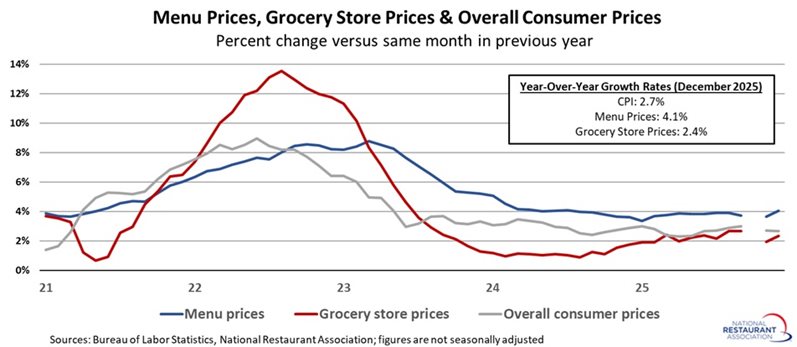
More current, though, consumer prices climbed 0.3 percent in December. Headline inflation hiked 2.7 percent, year-over-year (similar pace to November; October didn’t publish data due to the government shutdown). Food prices jumped 0.7 percent, offset somewhat by gasoline prices being down 0.5 percent.
That 0.7 percent growth was the fastest since October 2022. In 2025, prices for food-away-from home average monthly growth of 0.4 percent. On a year-over-year measure, menu prices bumped 4.1 percent since December 2024, the highest-year-over-year growth figure since July 2024.
All to say, menu inflation held firm last year. But it wasn’t the 8.8 percent peak observed in March 2023, which was the fastest in more than two decades.
And grocery prices increased 0.5 percent in December as well. That sector averaged 0.3 percent growth per month in 2025.
Broken down, menu prices at full-service restaurants upped 0.8 percent in December, with prices averaging 0.4 percent growth each month in 2025. Quick service saw a 0.6 percent uptick in December and a 0.3 percent monthly rate for the year.
Year-over-year, full-service menu prices hiked 4.9 percent in December. Quick service increased 3.3 percent.
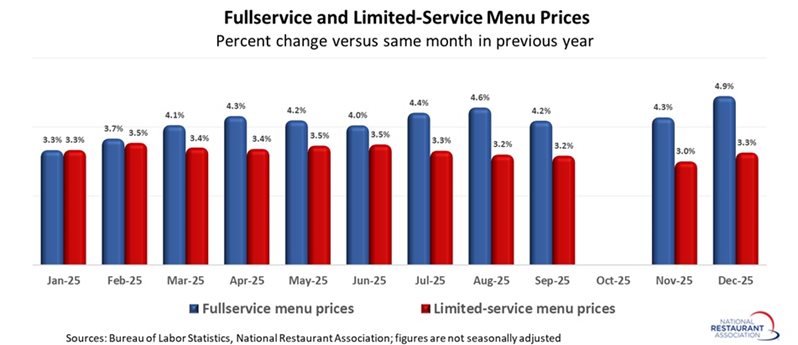
Once more, even with material growth, there was clear moderation in the mix. Full-service menu prices rocketed as high as 9 percent, year-over-year, in 2022. Quick service hit 8.2 percent in April 2023.
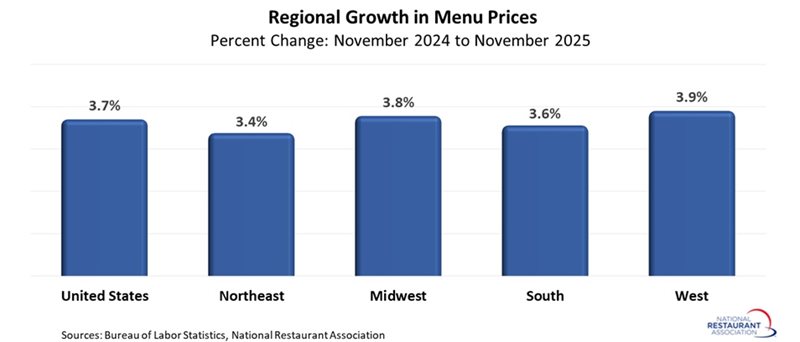
This past year saw a pretty even climb nationwide. But, zeroing in on December, the Northeast (1.2 percent), West (0.7 percent), South (0.6 percent), and Midwest (0.5 percent) sloped higher. In the past year, the West (4.3 percent) and Northeast (4.2 percent) reported the fastest menu price growth. The Midwest (4 percent) and South (3.9 percent) followed.
So, returning to ground-level insight, the industry’s “food cost crisis,” as TouchBistro called it, intensified in 2025 (hence, the ongoing price hikes), with 54 percent of operators citing rising food costs and inflation as their biggest inventory challenge. It was 39 percent a year ago.
The sharp increase, the company noted, reflected a fresh reality—tariffs and trade restrictions challenged bottom lines.
A full 82 percent of operators said these policies contributed to their restaurants inventory issues. The impact varied slightly by region. Miami (91 percent) and Austin (90 percent) felt the heaviest burden. L.A (64 percent) was on the other side, even though it was still two-thirds of polled operators.
As for how much restaurants are spending on food, TouchBistro’s data landed on 35 percent. That’s about level with the previous year. Still, 2025’s impact was more widespread.
Biggest inventory challenges in the past year
Rising food costs and inflation
- 2025: 54 percent
- 2024: 39 percent
Food waste
- 2025: 16 percent
- 2024: 18 percent
Vendor management
- 2025: 15 percent
- 2024: 23 percent
Supply and ingredient shortages
- 2025: 12 percent
- 2024: 20 percent
None
- 2025: 4 percent
- 2024: 0 percent
Impact on tariffs and trade restrictions on inventory challenges by city
- Miami: 91 percent
- Austin: 90 percent
- Chicago: 82 percent
- Tampa: 77 percent
- Houston: 70 percent
- New York City: 68 percent
- L.A.: 64 percent
In 2024, less than half of operators said they stayed clear of menu price increases. Restaurants were easing up after widespread sticker shock and trying to regain lost traffic stemming from higher tickets and cautious consumer spend. That restraint in 2025 proved unstainable, however, due to tariff pressures. Sixty-eight percent of respondents said they ended up raising prices last year—a sizable jump from 47 percent in 2024. Although, they did atempt to hold the ceiling with more modest takes (how much could they lift after years of doing so?): Operators said they raised by an average of 12 percent compared to 14 percent in 2024.
Those increases, TouchBistro said, weren’t arbitrary. Restaurants evaluated which items could absorb price adjustments and which needed to hold the line to protect the value proposition. The result was more strategic pricing that balanced covering costs while preserving loyalty.
Put another way, operators became more nuanced with where they took price since it’s rather difficult now to blanket hike across the board without getting dinged by guests.
And there were other menu changes, too. The survey revealed a focus on specialized diets (vegan, gluten-free, vegetarian options, and non-alcoholic beverages) declined sharply from 2024 levels. The pullback likely reflects operators simplifying operations to focus on core offerings rather than niche categories that add inventory complexity, TouchBistro said.
One operator shared they were forced to cut down on menu items and offer high-margin products they knew would be available. Another noted they reworked inventory setup and introduced clearer documentation as food costs rose and cost of sales percentage started to surge. Doing so helped reduce discrepancies and allowed for more control, leading to better performance and even higher team morale.
A New Jersey restaurateur said they downsized the menu to focus on popular items and made seasonal changes based on customer feedback. “Involving guests in the process has helped guide smarter menu decisions and build loyalty,” they said.
Commitment to locally sourced ingredients remained a strong pull. Thirty-nine percent of full-serves said they plan to add more in the next six months. Operators also reported turning to more affordable ingredients, revisiting portion sizes, repurposing leftover ingredients, and simplifying menus to combat rising costs.
Planned menu additions (next six months)
More locally sourced ingredients
- 2025: 39 percent
- 2024: 42 percent
More vegetarian options
- 2025: 30 percent
- 2024: 41 percent
More non-alcoholic drink options
- 2025: 27 percent
- 2024: 40 percent
More vegan options
- 2025: 25 percent
- 2024: 42 percent
More diet-specific options
- 2025: 25 percent
- 2024: 37 percent
TouchBistro suggested operators look at strategic price hikes, not uniform ones, and redirect focus to stronger-margin products where customers expect higher pricing, such as specialty dishes or premium cuts. Operators should also simplify before they substitute. You can often save more by slicing low-margin, operationally complex dishes instead of swapping in cheaper ingredients.
And lastly, watch trends, don’t chase them. Per this survey, locally sourced ingredients would be a good place to start versus specialized diet options, for example.