
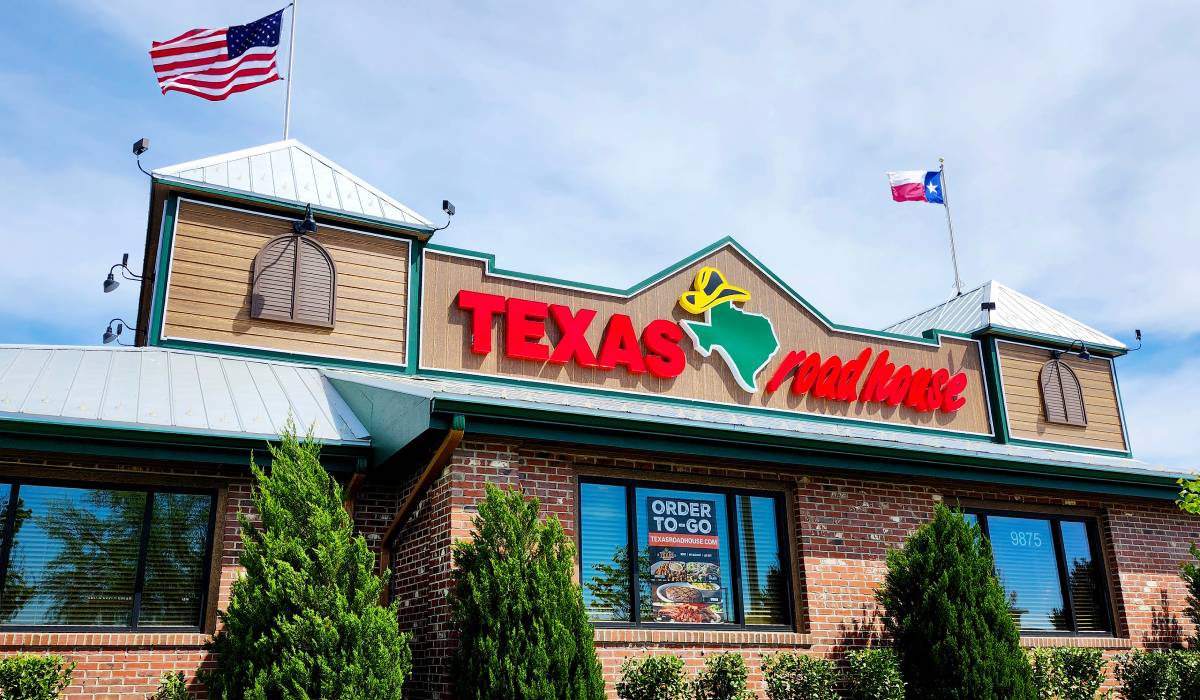
As Texas Roadhouse CEO Jerry Morgan explained Thursday, “the game is never won in the first quarter.” But a start like this never hurts, either.
The brand opened fiscal 2026 with same-store sales growth of 7.1 percent, good for a two-year stack of 10.6 percent. Texas Roadhouse’s traffic lifted 4.5 percent and is up 5.6 percent over two years.
Average weekly sales in Q1 reported at $174,151, of which $25,374 stemmed from to-go sales—the largest mix since early pandemic trends. Both compared favorably to prior-year measures of $163,071 and $22,146, respectively. Momentum carried into Q2 as well, with same-store sales tracking 6.5 percent through the first five weeks.
While a stellar early 2026 run, there’s little to suggest Q1 will prove an outlier for Texas Roadhouse. If you strip 2020, the brand has posted 61 consecutive quarters of comps growth, which takes us back to the 2010 launch of Instagram.
“Our operators are focused on the work and opportunity that lies ahead,” Morgan said. “We are confident that Roadie Nation is up for the challenge of kicking it up [a reference to Texas Roadhouse’s managing partner conference theme this year] and continuing to grow our brands.”
Texas Roadhouse’s Q1 was littered with green shoots, and some optimistic go-forward trends on potential commodity relief. Revenue surpassed $1.6 billion, growing 12.8 percent, and, given the challenged climate, Morgan said, Texas Roadhouse’s traffic and mix results show guests “continue to trust us to provide an experience worth of their time and money.”

Come hear Jerry speak at our annual conference! Registration is now open here.
Average check lifted 2.6 precent and mix was steady, with 50 basis points of negativity coming form lower drink attachments rates as to-go expands. Price was 3.1 percent. It will be 3.6 percent in Q2 and Q3 and 1.9 percent in Q4 plus whatever Texas Roadhouse might tack on at the start of the quarter.
To-go generally carries a lower average check.
Traffic rose 4.3 percent in January, 5.7 percent in February, 3.7 percent in March, and 3.5 percent thus far in Q2. Same-store sales hiked 6.9, 8.3, and 6.3 percent in those Q1 months, respectively.
Texas Roadhouse opened four locations and expects about 35 for the full year, including as many as nine across its three brands (Bubba’s 33 and Jaggers) in Q2. So, weighted back-half development. A franchised Jaggers debuted as well, as did an international Texas Roadhouse.
Morgan spent a solid portion of Thursday’s earnings call talking about technology and to-go. The former is something the brand keeps running through a filter of guest experience. Morgan has said over the years Texas Roadhouse looks at ways to enhance store energy and execution, not move the labor line around. Its digital kitchen technologies, or KDS, supports operators, he said, as Texas Roadhouse executes a higher volume of off-premises business (it’s still not doing delivery). The goal being to flow those orders without negatively impacting dine-in experience.
The company has also been encouraged by early feedback from upgraded handheld tablet tests, where servers input orders at the table. Texas Roadhouse plans to “slowly” expand the pilot after feedback.
To-go in particular has been an evolving arm of Texas Roadhouse’s business. It was essentially immaterial pre-COVID, when the chain averaged weekly sales of $118,512 leading up to lobby closures. Of that, only $9,116 came outside the four walls (it would balloon to $60,000-plus in late April).
Naturally, there’s a stark difference between a channel being the only option for customers and being one still worth tapping when dine-in is also available. So, Texas Roadhouse steadily improved. Morgan said the technologies it’s using to help manage the business have helped, but it comes down to the ease of placing an order through the app, the pickup windows it now has, and how transactions occur. “People grab their food, get home, and have everything they ordered,” he said. “Our to-go food travels well, and we are continuing to improve upon it. It is resonating with guests. We never have enough rolls and butter in there. But we keep trying hard. It is about demand for our product and the execution our operators continue to focus on.”
Not unlike how Texas Roadhouse operates inside stores, Morgan said, to-go is a battleground of fundamentals. The brand emphasized accuracy and making sure customers arrive home with everything. It’s revamped parts of the order guide, added pictures, refined language to make ordering easier through customer response and its own learnings. Texas Roadhouse streamlined pickup at the window and operators dedicated employees over.
“It is growing because of the effort we put in,” Morgan said, “delivering on the promise of legendary food and legendary service, and the ease of pickup.”
Texas Roadhouse doesn’t market to-go. The food and brand take care of that, Morgan said. And Michael Bailen, VP of investor relations, added so long as the dining room is full and expanding, to-go remains beneficial to margin dollars and is “probably” slightly beneficial to overall restaurant margin percent. “You can allocate costs between the two differently and make one look more or less profitable,” he said. “But at the end of the day, if we keep the dining room busy and add incremental to-go, I would expect a little benefit to the margin percent and a strong benefit to dollars.”
Restaurant margin percentage decreased 36 basis points in Q1 to 16.3 percent due to a 122-basis point increase in food and beverage costs, primarily from 6.2 percent commodity inflation (challenges with rising beef figures).
On the larger technology effort, Morgan reiterated it’s there to “enhance the experience.”
“We have a workforce very used to technology,” he said. “Handhelds may speed things up when placing and sending orders, but the motivation is not to run more tables. It is to be more efficient and improve the complete guest experiences.”
“We want our servers comfortable,” Morgan continued, “whether using a hardwired POS or a handheld. We have seen order accuracy improve with handhelds, which we like. We are still working on it and going slow. But attitudes are favorable.”
The KDS, he added, helped with turnover and productivity (one leading to the other) given it’s created calmer kitchens that allow cooks to view the screen and know what they have to do. It also lets operators track cook times and identify things stores previously did manually.
Additionally, pay-at-the-table—another Texas Roadhouse tech lever—empowered customers to check out on their own clock. “That has been a big win for the consumer and our operators,” Morgan said.
The chain’s guest management upgrade helped it manage dining rooms and seat people quicker and more efficiently at the right-sized table.
“Technology is designed to enhance the guest experience, and it is doing that,” Morgan said. “It is also enhancing the employee experience by doing some of the math for our positions and helping managers run their business more efficiently. Altogether, it is definitely helpful.”
Texas Roadhouse’s managing parter conference took place a week ago in Nashville. Morgan said “Kicking It Up” was chosen because operators are invested in elevating what’s already been some of the most consistent results in the industry.
Mike Lenihan, named CFO in December after serving in the same function at CKE Restaurants, said he spent much of the quarter training in Texas Roadhouse and Bubba’s 33 locations. And he took in the event for the first time. “It was an incredible way for me to experience our culture and celebrate what has and will continue to make this company so special,” he said.
Bubba’s 33 and Jaggers delivered positive same-store sales in the quarter as well, he said. Bubba’s reported comps of 0.9 percent (4.8 percent two-year stack). The company doesn’t break Jaggers out exactly, but noted weekly sales were north of $71,000.
Bubba’s 33, which has 56 restaurants compared to 50 a year ago, generated average weekly sales of $123,624. Jaggers closed at 10 units on the company side and seven franchises (six domestic). There were 657 U.S. company Texas Roadhouses, 31 franchised, and 61 international. Overall, the enterprise directs 822 restaurants versus 792 this time last year.
Morgan said Bubba’s 33 remains top of class in its category and stokes energy similar to Texas Roadhouse, but with a more rock-and-roll vibe. The company tried a smaller prototype and has two up and running. “We will continue to evaluate it as we build more,” he said. “We have had a couple of conversations that we are very excited about from a profitability standpoint. We are looking at options to ensure Bubba’s can bring burgers, pizzas, wings, beer, margaritas, and fun to any community we enter.”
Largely, though, it’s the same playbook as Texas Roadhouse: boots on the ground, operators shaking hands, and stores being community partners. Then, first and foremost, Morgan said, delivering when somebody shows up. “Greet at the front door, get them seated and fed, let them watch sports and have an ice-cold beer, pizza, burgers, wings and fun, and make sure they feel appreciated,” he said.
On the topic of inflation, first-quarter impact came in slightly better than expected (6.2 percent). Given increased visibility into the back half of the calendar, Texas Roadhouse reduced its full-year commodity inflation guidance from about 7 percent to 6–7 percent.
The current expectation, Lenihan said, is to be at the top end of the guidance in Q2 (7–8 percent) but at or below the bottom part for the latter portion of the year.
Bailen said supply issues are “well known” and have not changed, but the company has noticed some demand shift within retail. While beef is still popular, some customers are purchasing different cuts, which is what’s reflected in the updated outlook.
Morgan said Texas Roadhouse has a “great selection” of chicken entrees and pork. But the chain is not trying to guide anybody anywhere. “We want them to come in and get the experience they want and the choice of food they prefer,” he said. “We have it available, and we are ready to serve it.”
Bailen said Texas Roadhouse has not observed a correlation between rising gas prices and traffic trends. People still want to go out and “have that simple luxury of a casual dining meal with friends and family,” he explained.
The brand continues to see strength across all regions and age groups and the trend of its highest comp restaurants also being its highest volume ones has held up.
“They are going to be pick as to where they go,” Bailen said. “And our value proposition likely benefits us. If someone is watching what they spend because they are paying more at the gas pump, Texas Roadhouse Inc. becomes a great option.”