
From grocery shelves to social feeds, the push for more protein has moved well beyond shakes and bars. It’s showing up in everything from fortified cold brews and protein sodas to high-protein ice creams, snack chips, and even candy.
Alcohol, so far, has been slower to follow. Major global beverage companies haven’t made a significant move into protein-enhanced beer, spirits, or cocktails, but a growing crop of startups and emerging players is testing the waters with everything from whey protein beers and spiked protein drinks to protein-infused vodka waters.
What does this trend look like behind the bar? And how, if at all, are bartenders incorporating protein-forward thinking into cocktail programs?
At The Dearborn, an upscale American tavern in Chicago, beverage director Sarah Clark is happy to track trends—but only if they make sense for her guests and her brand. For her, protein-forward cocktails start to look shaky the moment protein powder enters the picture. She’s personally used plenty of powders in shakes and smoothies, but behind the bar, she sees a hard line. The Dearborn’s cocktails are designed around a specific flavor target and then engineered backward. Introducing an ingredient that’s main purpose is nutritional, not sensory, can topple the whole structure.
“It’s really, really hard—and I don’t actually know that it’s even achievable—to have a cocktail where you put some sort of supplemental protein in there, and you don’t taste it or have it take over the nuances of the drink,” she says.
Just as important, Clark doesn’t see real demand. Her guests are happy to chase protein at breakfast or lunch, but once they sit down at the bar, priorities shift. “Are people that are consuming alcoholic beverages focused on trying to get their extra protein in that way? I don’t personally think so,” she says.
Where protein-adjacent techniques do make sense, Clark is already using them—just not under a “protein-forward” banner. She points to aquafaba as a vegan stand-in for egg whites and to the rise of milk punches, where dairy-based clarification quietly brings protein into the glass.
One standout at The Dearborn is the Punch! Boom! cocktail, a clarified milk punch built on matcha-infused Koval rye vodka and strawberry-infused Grey Goose, layered with yuzu, lime, and a hint of pandan. The mixture is poured over white chocolate ganache to create the milk punch effect, then stirred, rested, and carefully strained until clear and silky, softening the drink’s edges while adding subtle richness.
Clark notes that in a milk punch, bartenders mix the cocktail with milk so the proteins can bind to cloudy particles and color. Those solids are strained out, but a small amount of protein and dairy character remains in the finished, crystal-clear drink.
Not everyone is as skeptical. Ahu Hettema, owner of Istanbul Hawai‘i, a Turkish restaurant in Honolulu, sees protein-forward cocktails as “a key part of 2026’s shift toward purposeful and functional drinking.”
“Guests are seeking cocktails that offer more than flavor alone,” she says, adding that they’re increasingly looking for satiety, recovery support, or wellness alignment “while still honoring the ritual of cocktail hour.”
Like Clark, Hettema is quick to point out that protein in cocktails isn’t new. Egg whites in sours and dairy in punches or milk-washed drinks have long provided texture and body.
“What’s new is the intention,” she says. “These elements are now being reframed through a functional lens, emphasizing balance and how a drink makes you feel afterward, not just how it tastes in the moment.”
In her view, that shift is showing up in newer expressions, from clear whey isolates or hydrolyzed collagen incorporated into bright, transparent drinks like gin & tonics, spritzes, or margaritas to plant-based options such as pea protein or collagen peptides in RTDs and bar programs, as well as savory “brothtails” using bone broth for umami and perceived wellness benefits.
At Istanbul Hawai‘i, that thinking has carried into menu development, including a spring cocktail built with collagen peptides and centered on themes of rebirth and wellness. “The goal is not to spotlight the ingredients,” Hettema says, “but to create drinks that feel quietly nourishing and intentional.”
For Justin Young, head bartender at Chicago’s Farm Bar, techniques like milk punch and bone broth cocktails aren’t always a fit. The neighborhood Midwestern tavern operates with a strong farm-to-table ethos—the owner is a farmer and beekeeper who supplies produce throughout the season—and Young builds his drinks around that pipeline of real ingredients.
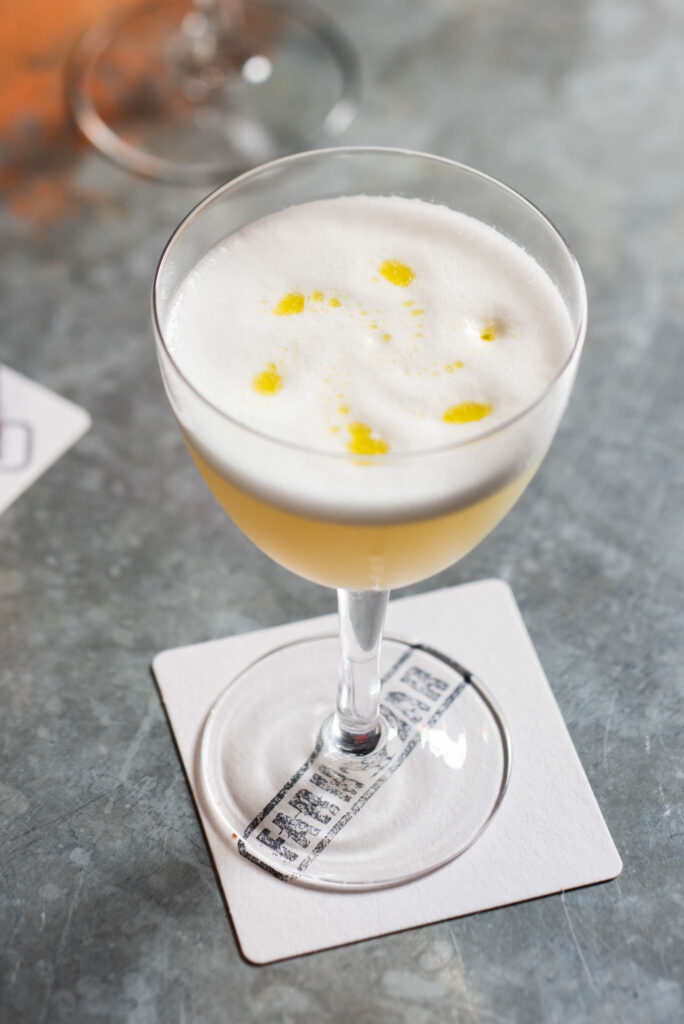
In his view, more involved techniques can be difficult to execute in a high-volume setting. Milk punches and similar preparations are labor-intensive, require careful storage, and can have shorter shelf lives, making them harder to manage without disrupting the rest of the program.
Looking at both his guests and the broader beverage landscape, Young doesn’t see much demand for protein as a wellness play in cocktails. What he does see are protein-based or food-driven techniques—meat, vegetable, or fat-based infusions—where protein functions more as a culinary tool than a selling point.
At Farm Bar, fat-washing is the primary expression of that idea. Young is developing a bacon fat–washed bourbon for a maple Old Fashioned, but his current obsession is a mushroom-washed mezcal that appears on the spring menu. He starts with crimini mushrooms sautéed in garlic butter, then combines them with mezcal in a sealed jar. After resting, the mixture is frozen for several days, allowing the fat to solidify and separate while the mezcal absorbs the savory flavors. The result is a clear, mushroom-scented spirit that forms the base of a bright cocktail with an herbaceous liqueur, tomato shrub, lemon, and a touch of tonic.
For Young, the appeal is less about protein content than about flavor.
“I’ve found that fat washing with proteins—whether it be bacon, a mushroom, or something else that’s protein rich—helps to give your cocktail a more savory element,” he says. “People are moving away from sweeter drinks, so they like something that has more umami and maybe a little bit more salt in it.”
At Denver’s Adventure Time Bar, owner Sam Wood arrives at a similar savory territory through a more high-concept lens. His rotating-theme cocktail bar has become a testing ground for protein-adjacent techniques, from a French Onion Soup Martini built on vodka washed with buttermilk, beef bouillon, and onion caramel to the Cyber Punk Punch, a mezcal-and-miso milk punch, and a Thai tea cocktail that uses a milk-and–coconut milk layer stabilized to mimic egg-white foam. He’s also experimenting with spirulina, a blue-green algae rich in protein and vitamins, as a color and flavor element in an upcoming menu.
For Wood, these techniques tie into a broader push toward umami and what he describes as “flavor hacking,” where the goal is to build drinks people want to keep sipping.
“You don’t want to make everything super sweet, or else people will end up feeling like they’re going to leave in a diabetic coma,” he says. “So, how do you get people to have another? You make it bitter, or sour, or savory, so they want another sip to keep washing their palate.”
He also sees a generational shift shaping the conversation. With younger consumers drinking less overall, Wood connects the rise of nonalcoholic cocktails—and now protein-forward framing—to a broader effort to make drinks feel more approachable.
“It’s almost like the NA push,” he says. “How do I make this appealing for people who don’t want to get hammered, but still want to relax a little bit and feel like there’s some benefit—or at least like it’s not the worst thing they could be ordering?”
In that sense, “protein-forward” can function as much as marketing language as technique, signaling a drink that feels less purely indulgent and more aligned with wellness, even when the underlying methods are familiar.
“To say that you’re not on board with it feels slightly silly,” Wood says. “We’ve been doing these things for shelf life and stability long before anyone started talking about them as ‘protein-forward.’”
Adventure Time hasn’t explicitly positioned drinks around protein—there are no grams-per-serving callouts yet—but Wood can imagine how it could fit within the bar’s rotating themes, such as framing protein-rich drinks as “health potions” or “barbarian’s rage” in a Dungeons and Dragons-inspired, medieval-themed menu.
For him, the opportunity lies less in adding protein for its own sake and more in how the concept can be used to reframe existing techniques. “The less we nay-say and the more open we keep our minds, the better the culture is going to be as a whole,” Wood says. “If there’s something cool and new happening, why wouldn’t you at least keep yourself abreast of it?”