
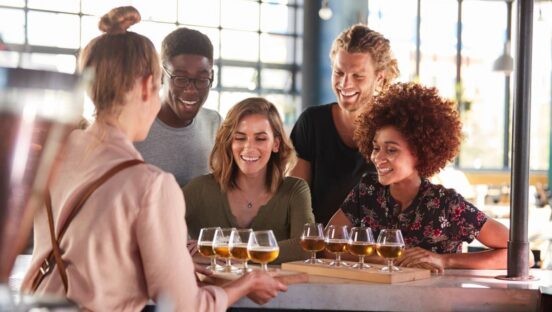
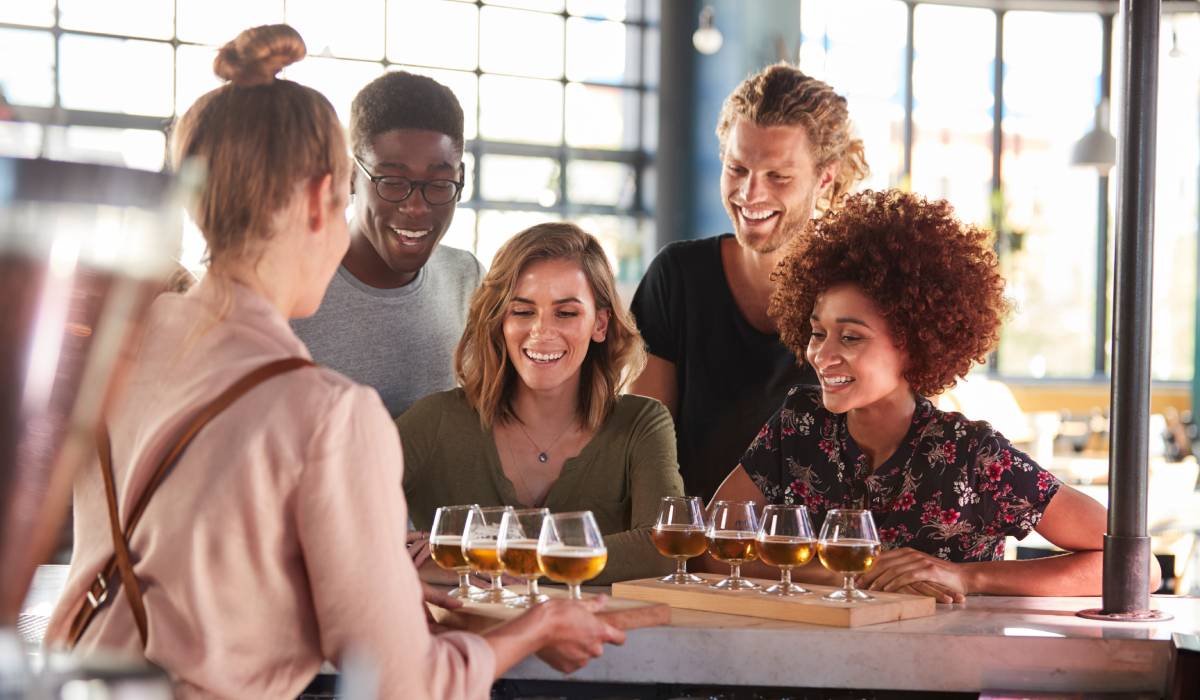
Alcohol sales have seen better days. But after a slow start, 2025 turned into a meaningful growth story for beer on-premise. While alcohol spending lost momentum in the first half of the year, the second half saw on-premise operators gain dollar share in the alcohol category, with beer leading the way.
That recovery reflects broader consumer behavior. People want to socialize, and they want to do it out of the house. A recent Eventbrite social study report reinforces what many operators are already seeing: Since COVID, Americans have been spending both their time and money away from home at an accelerating rate.
Away-from-home food and beverage spend has trended upward since its 2020 drop, surpassing $1 trillion in 2025. For restaurant and bar operators, that context matters. The beers consumers drink at home are rarely the ones they order at the bar.
The macroeconomic backdrop is also favorable. Alcohol away-from-home commands a pricing premium over retail, and the labor market remains strong: Hourly earnings rose nearly 4 percent from 2024, with more people employed in the U.S. than ever on record.
Beer is a Bright Spot in a Challenging Category
A review of 2025 anonymized beer purchase data from Fintech, covering more than 145,000 on-premise businesses (restaurants and bars) across the U.S., shows beer standing out amid an otherwise declining alcohol market. For operators running on thin margins, that distinction matters. Restaurants and bars grew their share of beer purchases by more than $300 million last year, a 2.6 percent year-over-year increase.
Packaging trends shifted notably as well. Kegs gained 4.5 dollar share points from bottles and cans compared to 2024, a $596 million gain for the draft category. That’s a signal worth heeding when reviewing tap programs and cost structure.
Draft Beer: Who’s Leading the Tap Lines
Consumer preferences differ meaningfully between packaging formats, and the draft category tells its own story. Michelob Ultra held the top share of dollars on draft at 16.7 percent in 2025, with a 1.4 point share gain year over year.
Miller Lite, Coors Light, Bud Light, and Blue Moon round out the top five draft brands, though each posted a modest share decline. Modelo Especial ranked sixth, gaining 2.3 share points year over year to reach 6.2 percent. This is a brand worth watching as it continues to build on-premise momentum.
On-Premise vs. Off-Premise: Where Brands Are Winning
Michelob Ultra maintained top dollar share both on- and off-premise in 2025, but its on-premise share of 1.3 points was nearly double its off-premise gain. This suggests the brand is resonating particularly well in the bar and restaurant environment. Modelo Especial ranked second, gaining just 0.1 share off-premise but 1.1 share at restaurants and bars, reinforcing its on-premise strength.
In the bottle category on-premise, Michelob Ultra again ranked first with 19.3 percent share of dollars. Miller Lite followed at 13 percent, Coors Light with 11.7 percent, and Bud Light 9.8 percent.
READ MORE: What’s On Tap? Beer Trends Point to Growth for Full-Service Operators
Low- and No-Alcohol: A Growing Segment
The low- and no-alcohol segment continues to attract operator attention. Heineken Zero held the top share of dollars in 2025, though the brand lost 3.2 share points year over year. Michelob Ultra Zero ranked second at 9.7 percent share.
With a 9.4 point gain year over year, it is the fastest-growing brand in the category for both on- and off-premise. As demand for non-alcoholic options grows, having at least one prominent offering on your menu is increasingly a baseline expectation. With more suppliers offering products in this category, there is no shortage of choices.
Beyond Beer and Craft: Rounding Out the Picture
In the beyond-beer category, White Claw maintained the top share of dollars in 2025, gaining 1.7 share points year over year. Twisted Tea followed at 16.6 percent, and Truly at 7.7 percent.
In craft beer, Blue Moon held the top position with 9.8 percent share of dollars, which remained flat from 2024. Voodoo Ranger ranked second at 8.4 percent, and Sierra Nevada at 6.8 percent.
Bank of America card data shows that spending at bars increased nearly 4 percent YoY in January 2026, but fell at liquor, wine, and beer stores. The divergence reinforces a broader shift in consumer behavior: people are increasingly choosing to drink out rather than at home. For restaurant and bar operators, this is an encouraging signal. Beer remains a reliable anchor for driving traffic and ultimately tab size.
Lester Jones, CBE, is VP Analytics and Chief Economist for the National Beer Wholesalers Association.